
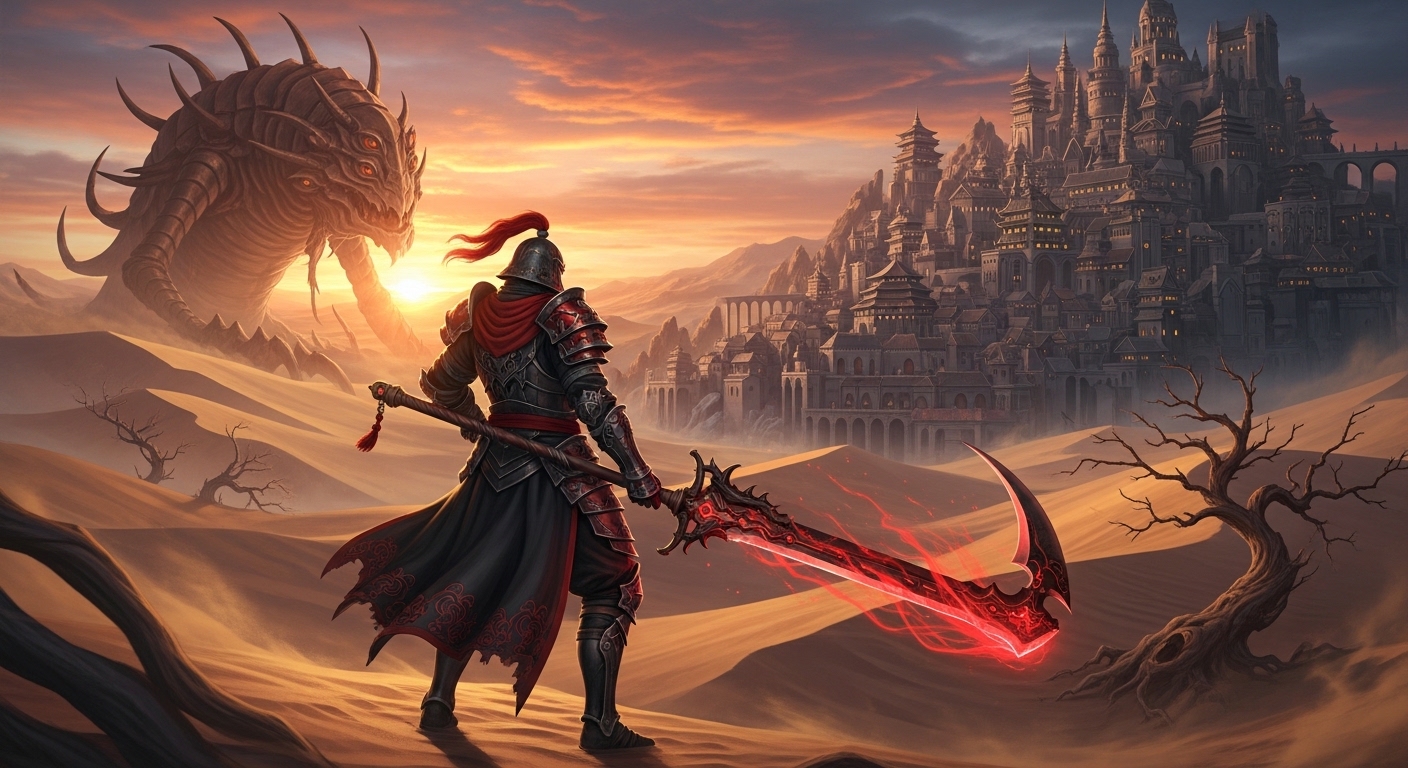
Crimson Desert Features: There are games that promise big worlds, and then there are games that seem to dare you not to believe them. Crimson Desert falls squarely into the second category. Since Pearl Abyss first pulled back the curtain on this open-world action-adventure, the gaming community has been equal parts mesmerized and skeptical — and for good reason. The sheer volume of confirmed features, systems, and mechanics packed into this single-player experience is almost unreasonable. But with its launch now imminent on March 19, 2026, the previews are in, the hands-on impressions are real, and the verdict is forming. If you’ve been waiting to understand exactly what Crimson Desert offers before you commit, this deep-dive guide covers every major feature confirmed so far.
The Open World of Pywel: Bigger Than You Think
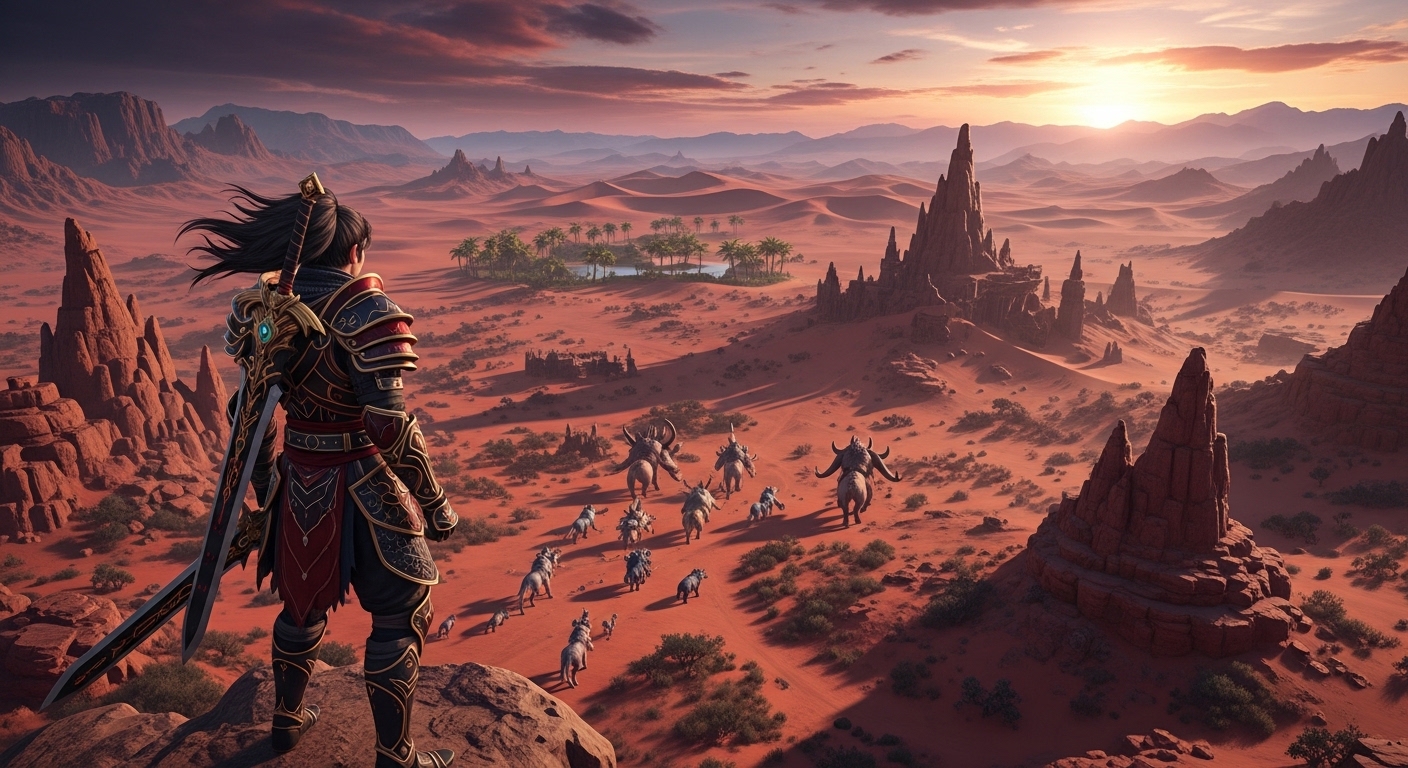
When Pearl Abyss describes the continent of Pywel as a “living, breathing” world, it’s not marketing speak — it reflects a design philosophy built around constant discovery. The developer has confirmed that Crimson Desert’s seamless open world is twice the size of Skyrim’s and even larger than Red Dead Redemption 2’s map. That’s an extraordinary claim, but the content backing it up is equally ambitious.
The world stretches across green plains, dense woods, arid deserts, rugged mountains, and bustling cities filled with residents from all walks of life. Between destinations, players encounter landmarks, ancient ruins, hidden treasures, and points of interest that reward curiosity. And it doesn’t stop at ground level — the journey eventually takes players skyward to the mysterious realm known as the Abyss, where a mystical imbalance endangering the world must be restored.
Five Distinct Regions to Explore
The world of Pywel is fully open and divided into five distinct regions, each with its own character and purpose. You can tackle quests, encounters, and hidden treasures across these regions in any order you choose, which gives the world a genuinely open feel.
Traversal: Climb, Glide, Ride, and Fly
Getting around Pywel is never a chore. Kliff can climb, glide, swim, sprint, and ride a horse across Pywel, all governed by stamina. Players can scale most cliffs and walls, glide over long distances, and use a whistle to summon a horse wherever they are.
The game takes a Zelda: Tears of the Kingdom approach to exploration — players can climb almost anything, use a glider-like set of wings to soften falls or cover ground in the air, and leap from sky islands in a fashion similar to TotK. Beyond horses, players can roam the lands on various mounts, including dragons and mechs.
Discovering Traces of the Abyss scattered throughout the world unlocks fast travel points to cut down on backtracking.
Crimson Desert Combat System: Deep, Brutal, and Rewarding
A Fighting Game Philosophy in an Open World
This is where Crimson Desert genuinely separates itself. Pearl Abyss didn’t design a casual hack-and-slash — they designed a combat system that demands attention.
At its core, Crimson Desert is a third-person action-adventure that leans heavily into combo-driven combat rather than the stat-grinding loops typical of traditional RPGs. The developers designed the combat to feel closer to a fighting game, with players chaining attacks, counters, dodges, and elemental effects in real time.
Several previewers compared it more to a fighting game mindset than casual hack-and-slash, stressing that timing, combos, and spacing all matter. That will be great news for players who want depth, though it sounds like it could be overwhelming at first.
Weapons Arsenal and Combo System
At the heart of Crimson Desert’s combat are weapon variety and seamless skill chaining. Players can wield an arsenal of weapons — from classic swords and shields to spears, greatswords, axes, and ranged weapons — each offering distinct tactical advantages.
The full confirmed weapon list includes:
- Sword and shield
- One-handed swords (including dual-wielding shortswords)
- Spears and polearms
- Greatswords and battle-axes
- Bows and muskets
- Bare fists and arm-mounted mini-cannons
Players get quick weapon switching across up to three slots, with unique movesets for each, supporting highly mobile combos and gap-closers.
It’s possible to chain weapon attacks together with unarmed strikes, kicks, and grapples for combo-oriented play, and players can broaden their tactical options through elemental enhancement, which imbues attacks with attributes like fire or ice.
Elemental Enhancements and Timing-Based Combat
A radial menu lets players instantly imbue weapons with elements such as Fire (burn damage), Frost (slow/freeze), and Shock (stun).
Defense isn’t passive either. By reading enemy movements and attack patterns, players can execute precisely timed guards and evasions, creating openings for counterattacks that can turn the tide of combat.
The system rewards skillful timing and positioning over button mashing, encouraging players to master the rhythm of each encounter.
Learn Skills From Enemies
One of Crimson Desert’s most inventive mechanics is how skills are acquired during combat. In a March 2026 PlayStation hands-on, Kliff could block, parry, lock on, and even learn moves from enemies during battle. One example had him copying a knight’s kick mid-fight and adding it to his own move set.
A number of skills are learned by observing them in the world — you might spot them at specific locations by entering “Observe” mode, or trigger the learning during combat when an enemy uses a technique you want to adopt.
Three Playable Characters With Distinct Playstyles
Crimson Desert features three playable characters with distinct styles: Kliff (balanced warrior), Damiane (stealthy rogue with a pistol, musket, and rapier), and Oongka (a heavy-hitting orc-kin brawler). The characters unlock progressively and feature separate skill progression trees.
Crucially, the game is about Kliff Macduff and his adventure through the world — you can stick with Kliff throughout and never switch to the other companions.
Progression System: No Grinding Required
The Abyss Artifact System
Crimson Desert throws out traditional leveling entirely. Character growth is tied to exploration, quests, and challenging encounters rather than fixed progression paths.
Central to character progression is the Artifact System, where Abyss fragments collected from quests, boss victories, and exploration unlock core stat boosts like Health and Stamina increases.
This means your power growth is tied directly to how thoroughly you explore and engage with the world rather than grinding repetitive encounters.
Equipment Crafting and Customization
Equipment crafting and customization offer another layer of progression. Gear can be purchased from merchants, discovered in hidden locations, or crafted from raw materials gathered through mining, hunting, and quest completion.
Each player will likely build a different version of Kliff — prioritizing stamina upgrades for longer exploration sessions, or focusing on unlocking diverse grappling techniques for melee dominance. The skill combination system ensures no two players’ Kliff will develop identically.
Boss Fights: 50+ Encounters Across Pywel
Based on what has been confirmed, Crimson Desert features at least 50 unique bosses for players to tackle as they complete quests and explore the open world. There are no difficulty options, meaning these encounters are likely to challenge just about anyone.
Confirmed bosses like the Staglord, Hexe Marie, and Queen Stoneback Crab all shift their mechanics partway through, so staying adaptable and avoiding over-commitment to attack windows early in fights is essential.
When players defeat a boss and equip the gear or outfit obtained, they gain special effects that allow them to use that boss’s signature skill. This turns every major boss fight into both a test of skill and a meaningful gear reward.
Life Skills, Side Activities, and Camp Building
Combat is only half the story. Crimson Desert is equally invested in giving players meaningful things to do between battles.
Life Skills and Activities
From cooking to fishing and rock climbing, players can also expect puzzles, faction management, and resource management.
The full list of confirmed life activities includes:
- Fishing — yields ingredients and sellable resources
- Hunting — provides materials for cooking and crafting
- Mining and tree chopping — core to gear upgrades
- Cooking — creates temporary combat buffs
- Alchemy — crafts potions, dyes, and consumables
- Pit fighting rings — bare-fisted combat tournaments
- Horse racing — with varied mount stats
- Tavern games and regional puzzles
The Greymane Camp
A substantial portion of the game involves managing resources, building up your base, and engaging with the world’s social and economic systems. You can establish and expand Greymane Camp using funds and resources gathered on your travels. The camp supports meal preparation, farm and ranch management, and furniture crafting and placement.
Comrades can be sent on independent missions across Pywel, returning with currency, resources, and crafting materials. You can also dispatch them to blockaded locations and enemy fortresses to weaken hostile forces without being physically present.
World Systems: Reputation, Factions, and Stealth
Crimson Desert builds out its world with RPG-depth systems that react to your behavior.
A full crime and bounty system similar to classic open-world RPGs means guards will pursue illegal actions, potentially leading to jail time or chases. Reputation affects NPC reactions, stronghold access, and story branches — positive actions raise it, while crimes lower it.
Full stealth mechanics include enemy vision cones on the minimap and silent take owns. Players can even hogtie and deliver criminals or enemies for bounties.
Platform Availability and Technical Features
Crimson Desert is available on PlayStation 5, PlayStation 5 Pro, Xbox Series X|S, Xbox on PC, Steam (PC & Mac), Epic Games Store, Mac App Store, and GeForce NOW.
For upscaling and image reconstruction, the game supports FSR 3/4 and DLSS 4/4.5 on PC, Upgraded PSSR for PS5 Pro, and FSR 3 for the PS5 base model and Xbox Series X|S. On Mac, it supports MetalFX Upscaler, Frame Generation, and Denoiser.
Cross-save is not available, and multiplayer is not available at launch. A Pearl Abyss earnings call from 2025 acknowledged the possibility of a future multiplayer mode, but nothing has been confirmed publicly.
Expert Opinion: What Makes Crimson Desert Stand Out
PC Gamer described Crimson Desert as a “Frankenstein’s monster of open-world fantasy games” — and that’s genuinely meant as a compliment. It pulls from The Witcher 3’s narrative grounding, Breath of the Wild’s exploration freedom, Dragon’s Dogma’s combat creativity, and Red Dead Redemption 2’s world density, and attempts to combine them into one coherent experience. Pearl Abyss’ PR Director confirmed the main campaign is only a small percentage of the overall content available, and the balance between narrative and gameplay sits somewhere between The Witcher 3 and Breath of the Wild.
That’s not a small claim. Whether Pearl Abyss actually sticks the landing across all those systems is the defining question — but based on the hands-on impressions leading up to launch, the bones are unmistakably strong.
Frequently Asked Questions (FAQs)
Is Crimson Desert a multiplayer or single-player game? Crimson Desert is a fully single-player experience at launch. Pearl Abyss mentioned the possibility of multiplayer in a future update during a 2025 earnings call, but nothing official has been announced.
What platforms is Crimson Desert available on? The game is available on PS5, PS5 Pro, Xbox Series X|S, PC (Steam and Epic Games Store), Mac App Store, and GeForce NOW.
Does Crimson Desert have a traditional leveling system? No. Instead of XP-based leveling, character progression is driven entirely by collecting Abyss Artifacts through exploration, boss fights, and quests, which unlock skills and upgrade core stats.
How big is the open world in Crimson Desert? Pearl Abyss has confirmed the open world of Pywel is twice the size of Skyrim and larger than Red Dead Redemption 2’s map.
How many playable characters are in Crimson Desert? There are three playable characters: Kliff (the main protagonist), Damiane (a ranged and rapier-focused rogue), and Oongka (a heavy brawler). Each has a distinct playstyle and separate skill tree.
How many bosses does Crimson Desert have? At least 50 unique bosses have been confirmed, ranging from human warriors and giant beasts to mechanical constructs and magical creatures. Many bosses feature mid-fight mechanic shifts.
Is Crimson Desert related to Black Desert Online? No. While both games share Pearl Abyss as their developer, Crimson Desert is a completely separate IP with its own world, story, and characters. There may be minor Easter eggs for BDO fans, but there is no shared story continuity.
Does Crimson Desert have microtransactions? No. The game is confirmed to be completely single-player focused at launch with no microtransactions.
Crimson Desert Pearl Abyss: Complete Guide (2026)
Crimson Desert: The Ultimate Guide: World, Combat, Characters, Features & Release Info

Surya Gupta is a professional blogger and SEO specialist with over five years of experience in digital content creation. He writes about technology, smartphones, games, trading, and trending topics. Through his websites, he aims to provide clear, accurate, and helpful information to readers.