
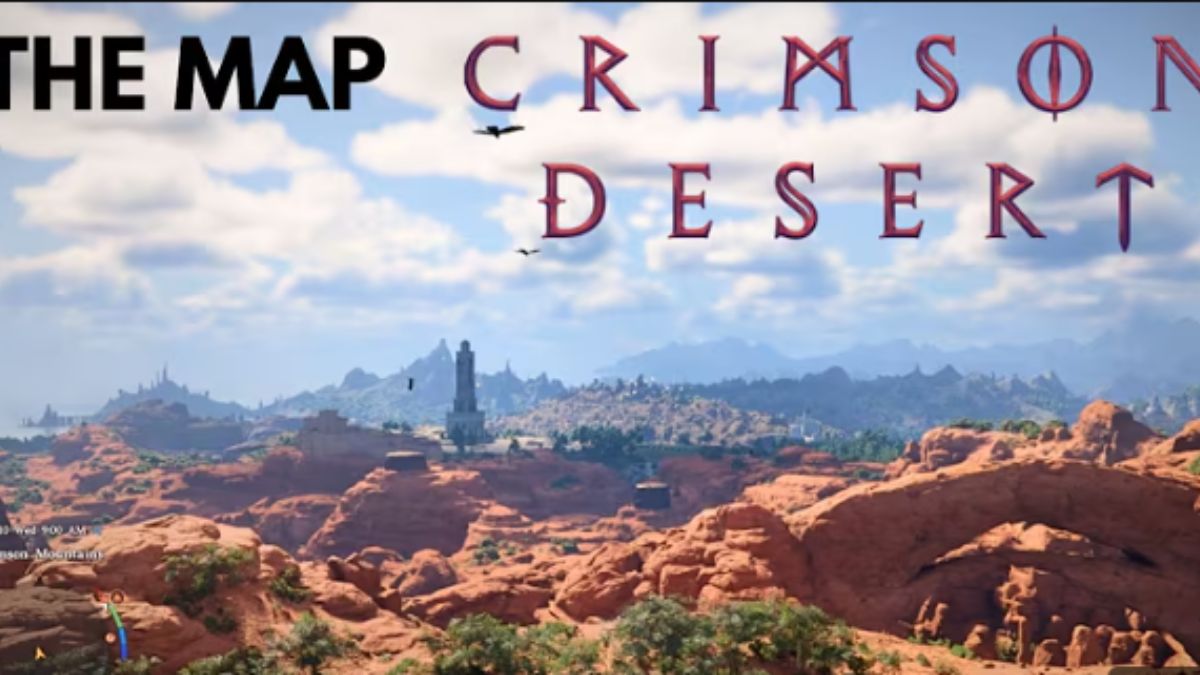
Crimson Desert Map: The moment you open the Crimson Desert map, it becomes immediately clear that Pearl Abyss has built something truly ambitious. The first time you set foot on the continent of Pywel alongside Kliff, the sheer scale of the world hits you in a way that feels genuinely overwhelming — and honestly, that is exactly the point.
If you are a fan of open-world giants like Skyrim or Red Dead Redemption 2, prepare to raise your expectations by another level. The map is not just large — it is layered, dynamic, and packed with something worth discovering in every corner.
In this guide, we cover everything about the Crimson Desert map — from a size comparison with other famous open worlds, to a detailed breakdown of every region, the 8 Bell Tower system, the fast travel network, and the exploration tips that every serious player needs to know.
Crimson Desert Map: Quick Overview
| Game | Crimson Desert |
| Developer | Pearl Abyss |
| Publisher | Pearl Abyss |
| Release Date | March 19, 2026 |
| Platforms | PS5, Xbox Series X/S, PC |
| Genre | Open-World Action RPG |
| Map Name | Pywel (Continent) |
| Map Size | ~90 km² (approx. 9500m × 9500m) |
| Total Regions | 5 Main + Abyss (Sky Layer) |
| Total Quests | 430+ |
| Mounts Available | 29 varieties |
Crimson Desert Map Size — How Big Is the World of Pywel?
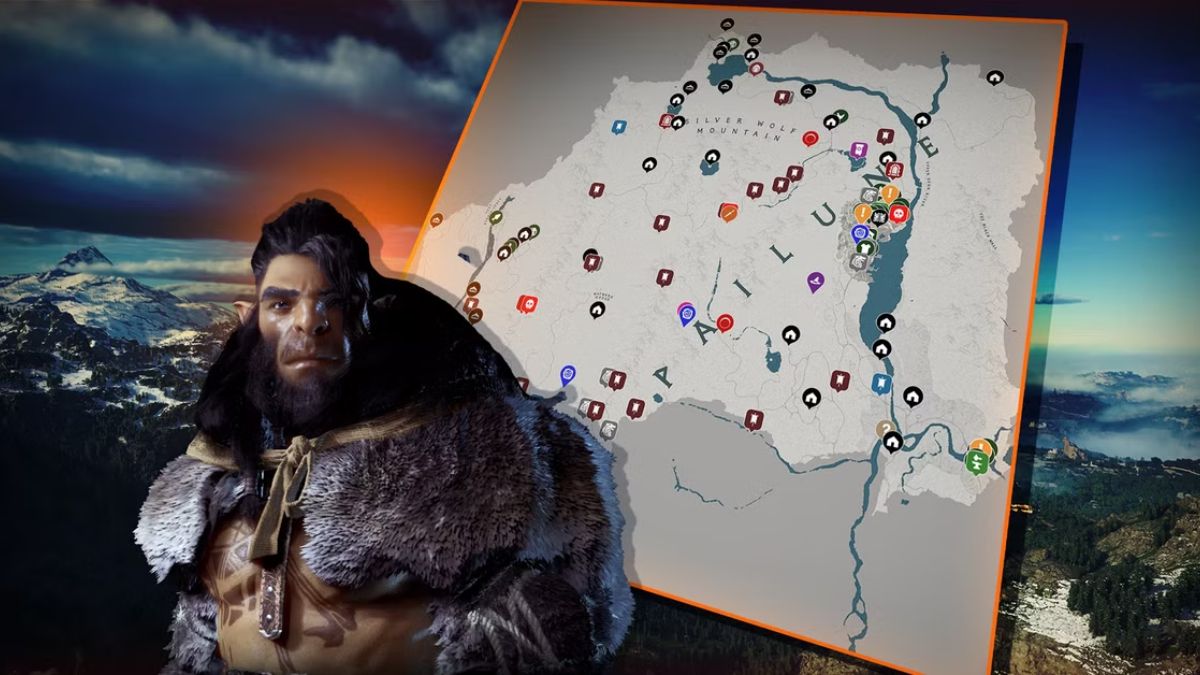
Let’s be direct — the Crimson Desert map is at least twice the size of Skyrim. Creative Director Will Powers confirmed this himself, stating that the world is at least twice as large as Skyrim’s playable area. In numbers, the estimated size sits somewhere between 80 and 110 square kilometers, with the officially measured map confirmed at approximately 90 km² (9500m × 9500m).
To put that in perspective:
Map Size Comparison Table
| Game | Estimated Map Size |
| Skyrim | ~37 km² |
| Red Dead Redemption 2 | ~75 km² |
| GTA V | ~87 km² |
| Breath of the Wild | ~80 km² |
| Crimson Desert | ~90 km² ← Winner |
| AC Valhalla | ~140 km² |
But size alone is not the whole story. The developers’ real promise is a concept they call “density of interactivity” — meaning every square kilometer should contain meaningful content, not empty filler. On top of that, the game includes a Sky Map layer — floating islands and aerial puzzles similar in spirit to Tears of the Kingdom — which pushes the total explorable area to roughly 100 km².
How Long Does It Take to Cross the Entire Map?
According to the developers, riding on horseback from one end of the map to the other takes approximately 2 hours. On foot, that number jumps to well over 6 hours. This makes it absolutely critical that you understand and invest in the fast travel system early — without it, simply getting from place to place will eat through your playtime fast.
All Crimson Desert Map Regions — Every Area Has Its Own Identity
Pywel is a seamless open world divided into 5 major regions. Each region carries its own political landscape, ecosystem, enemy types, and atmosphere. Moving from one area to the next is a noticeable shift in tone and gameplay feel.
1. Hernand — Where Your Journey Begins
Hernand is the first region players are introduced to, and it is easily the most polished and accessible part of the game. Large medieval cities, lush green fields, and a classic European high-fantasy aesthetic make this area immediately inviting — reminiscent of the worlds found in Dragon Age or The Witcher. Do not let that comfort fool you, though. Political intrigue, rival factions, and layered hidden stories run deep here.
All three of the starting Bell Towers are located in Hernand, making this region your primary destination for unlocking the map in early game. Expect to spend your first 15 to 20 hours almost entirely here.
What you will find in Hernand:
- First reliable fast travel hub — Hernand Town Center
- Witch Elowen NPC — important quest character
- Scholastone Ruins — tied to research questlines
- Pororin Village — side quests and early collectibles
2. Pailune — Frozen Mountains and Harsh Terrain
Everything that Hernand is warm and welcoming, Pailune is the opposite. Located in the north, this snow-covered and brutally harsh region turns the terrain itself into an enemy. Mountains are steep, visibility is poor, and the climate is genuinely dangerous in a mechanical sense. The temperature gauge that sits around the minimap begins to drop in Pailune, and when it reaches a critical threshold, Kliff suffers real stamina penalties — slower regeneration and heavier drain during movement and combat.
Pailune also carries narrative weight. The origin story of Kliff and the Greymanes is deeply connected to this region, giving it an emotional significance that goes beyond just cold weather and difficult terrain.
Tip: Before exploring Pailune, equip Ice Resistance armor or stock up on consumables like Beer or Honey Tea to counter the temperature penalty.
Notable bosses in Pailune: Staglord and White Horn.
3. Demeniss — The Political Heart of Pywel
Demeniss serves as the political capital of the continent. This is where large-scale military activity, siege battles, and faction warfare play out at their most intense. If you are looking for the grand, epic side of Crimson Desert’s combat and story, Demeniss is the center of it all.
- Demeniss City Gate — a must-activate fast travel point
- Spire of Clockwork — key landmark in the eastern portion of the region
- Serpent Marsh — located near Witch huts and Monk villages
4. Delesyia — Technology and the Unknown
Delesyia is Pywel’s most technologically advanced region. Here, players encounter mechanical beings, robots, and otherworldly creatures that feel completely out of place in the otherwise medieval world — and that contrast is intentional. The visual identity of Delesyia is distinctly different from everything else in the game, leaning futuristic and bizarre in a way that keeps exploration genuinely surprising.
Delesyia’s headline boss is Golden Star — a massive mechanical dragon widely considered one of the most spectacular boss encounters in the entire game.
5. The Crimson Desert Region — Lawless Red Sands
This is the region that gives the entire game its name. A vast, arid expanse covered in crimson-red sand, completely lawless and unforgiving. Brigands roam freely, the enemies are powerful, and the oppressive atmosphere sets in the moment you cross the border. Two of the game’s eight Bell Towers are located here.
6. The Abyss — A Separate Dimension Above the World
The Abyss is technically a separate layer of the map — sky islands, floating platforms, and a mysterious dimension connected to Pywel’s deeper magic. This is where you will find the Library of Providence, face the Hexe Marie boss encounter, and access Abyss-linked fast travel points. Each sky island contains a teleporter that allows you to skydive directly back down to any region of Pywel below you.
How to Reveal the Crimson Desert Map — 8 Bell Towers Guide
When you open the map for the first time, almost everything is covered in a thick grey fog of war. Passive exploration alone clears this fog painfully slowly. The most efficient method — by a wide margin — is to find and ring all 8 Bell Towers.
How the Bell System Works
Each Bell Tower is positioned in a specific region of the map. When you ring a bell, a Shai child appears and magically clears the fog of war across the entire surrounding region — roads, settlements, geographic features, all of it becomes visible at once. Ring all 8 bells and the entire continent is automatically revealed in full.
Bell Tower Distribution:
- Hernand: 3 bells — starting area, most accessible
- Pailune: 1 bell
- Demeniss: 1 bell
- Delesyia: 1 bell
- Crimson Desert region: 2 bells
The Smart Route for Bell Hunting
The most experienced players recommend a simple but effective approach: prioritize ringing all the bells before worrying about anything else. On horseback, you can bypass most enemies entirely without engaging in combat. As you ride toward each bell, activate every fast travel point you pass along the way. In one single sweep across the continent, you will open the full map and build out your fast travel network at the same time.
Crimson Desert Fast Travel System — Abyss Nexus and Cressets Explained
The fast travel system in Crimson Desert is not the kind where you climb a viewpoint and unlock everything around it automatically. Every single fast travel point has to be physically discovered and manually activated. Nothing is given to you upfront.
Two Types of Fast Travel Points
- Abyss Nexus (shown in blue on the map): These are the standard teleporters found near major towns, ruins, and key landmarks. Simply step onto them to activate. They are the most common fast travel method and the easiest to use once discovered.
- Abyss Cressets (Secret Points): These hidden fast travel locations sometimes require you to solve a small environmental puzzle or use a specific ability to activate. The reward for doing so is greater than a standard Nexus — Cressets grant fast travel access and also provide Abyss Artifacts and skill points, making them doubly valuable.
How to Find Hidden Fast Travel Points
Keep a close eye on your map for white question mark icons labeled as Mysterious Energy. When you spot one, head to high ground nearby and use your Blinding Flash ability — it projects a silvery glint that pinpoints the exact location of the hidden point. Always zoom in while scanning, because these markers disappear when the map is zoomed out too far.
Essential Early Fast Travel Points to Activate in Hernand
- Hernand Town Center — the most critical hub in the game; you will return here constantly
- Hernand Stables (north of the city) — the closest backup point to the city
- Kuku Iron Pot (west) — useful for crafting routes
- Pororin Village Nexus — essential for side quests and early exploration
- Witch Elowen’s Home — tied to early story progression
- Howling Hill Secret Teleporter — unlocks in Chapter 4, highly valuable
The Abyss Skydive Shortcut — An Underrated Travel Method
Here is a trick that very few guides explain clearly. From any sky island in the Abyss, you can skydive directly into any region of Pywel below. If there is no ground-level fast travel point near your destination, use the Abyss route instead — teleport to a sky island and drop straight down onto your target area. The character Damiane even has her own dedicated glide mechanic, making this approach even more flexible in her hands.
Crimson Desert Map Exploration Tips for Beginners
Seeing a map this large for the first time can easily feel overwhelming. These practical tips will make your exploration far smoother from the very start:
- First priority: Activate the Hernand Town Center fast travel point — you will return here constantly to offload loot and repair gear
- Use the map filter: The Mysterious Energy markers only appear under the ‘All’ or ‘Environment’ tab, not in the default view
- Follow the roads: They naturally connect settlements and often lead directly to the next Bell Tower
- Monitor the temperature gauge: Prepare cold resistance gear for Pailune; manage heat carefully in the Crimson Desert region
- Learn the minimap icons: Orange = quest NPCs, Purple = bounties and sealed artifacts, White = fast travel nodes, Bell icon = Bell Towers
- Unlock mounts early: With 29 varieties available — horses, bears, raptors, and more — mounted travel is the fastest ground method by far
- Level up Blinding Flash: This ability is the single most useful tool for discovering hidden content throughout the entire game
What Makes the Crimson Desert Map Unique
A Dynamic NPC System That Remembers Your Actions
The NPCs of Pywel are not static decorations. They have their own daily lives and routines, and the world reacts to what you do in it. Free a town from attackers, destroy a bridge, or eliminate a local threat — and the world shifts in response. New NPCs can arrive, trade routes can open up, and communities rebuild. The map is not just large; it is alive.
Underground Areas and Multi-Layer Exploration
The surface of Pywel is only part of the picture. The game contains over 100 caves and a wide range of underground locations to explore beneath the surface. Add the Abyss sky layer on top of that, and the total explorable space comfortably exceeds the official 90 km² figure.
430+ Quests and a Wealth of Side Content
A map this size needs content to justify it, and Crimson Desert delivers. With over 430 quests available — covering fishing, cargo delivery, bounty hunting, faction warfare, and much more — the side content alone could keep a dedicated player busy for hundreds of hours.
Pros & Cons — The Crimson Desert Map
| PROS | CONS |
| Map is at least twice the size of Skyrim | Fog of war feels overwhelming at first |
| 5 distinct biomes with unique aesthetics | Fast travel system takes time to understand |
| Multi-layered world (underground + sky islands) | Traversal without mounts is very tedious |
| Dynamic world that reacts to player choices | Some early guides are outdated after Day 1 patch |
| 430+ quests with dense, meaningful content | Certain areas require specific abilities to access |
| 29 different mount varieties to ride | Rushing the map means missing a lot of content |
Expert Opinion
The Crimson Desert map design is a genuine statement of intent. Pearl Abyss did not just win a size competition — they built a world where every region carries its own distinct personality and identity. The combination of the Bell Tower system, the discovery-driven Abyss Nexus mechanic, and the multi-layered exploration creates an open world experience that executes Elden Ring’s philosophy of discovery at a truly massive scale. If you are patient and genuinely interested in uncovering every corner of Pywel, this world will keep you occupied for months.
Frequently Asked Questions (FAQs)
Q1. How big is the Crimson Desert map?
The Crimson Desert map is approximately 90 km² (9500m × 9500m), making it at least twice the size of Skyrim. When you include the sky islands of the Abyss and the underground cave network, the total explorable area reaches roughly 100 km² — larger than both GTA V and Red Dead Redemption 2.
Q2. How many regions are in Crimson Desert?
There are 5 main ground regions — Hernand, Pailune, Demeniss, Delesyia, and the Crimson Desert region. Additionally, the Abyss serves as a separate sky and dimensional layer, filled with floating islands, puzzles, and its own unique bosses and fast travel points.
Q3. How do you remove the fog of war in Crimson Desert?
Find and ring all 8 Bell Towers scattered across the continent. Each bell summons a Shai child who clears the fog across the surrounding region. After ringing all 8 bells, the entire continent is revealed automatically. Start in Hernand, where 3 of the 8 bells are located.
Q4. How does fast travel work in Crimson Desert?
Fast travel is entirely discovery-based. Both Abyss Nexus points and Abyss Cressets must be physically found and manually activated — nothing is unlocked by default. Once activated, they can be used freely from the map screen. Cressets also reward Abyss Artifacts and skill points alongside fast travel access.
Q5. How long does it take to cross the full Crimson Desert map on horseback?
According to the developers, riding on horseback from one end of the map to the other takes approximately 2 hours. On foot, the journey exceeds 6 hours. This makes building out your fast travel network an essential early-game priority rather than an optional convenience.
Q6. How do you find hidden fast travel points in Crimson Desert?
Look for white question mark icons labeled Mysterious Energy on your map — only visible under the ‘All’ or ‘Environment’ tab. When you find one, climb to high ground and use the Blinding Flash ability, which projects a glint marking the exact location. Always zoom in when scanning, as these markers disappear at full zoom-out.
Q7. Are all regions accessible from the start in Crimson Desert?
All five main regions are technically accessible from the beginning of the game. However, some fast travel points and specific areas are locked behind ability requirements or story progression gates. It is strongly recommended to fully explore Hernand first and unlock key abilities before pushing into the more hostile regions.
Q8. What does the temperature system do in crimson desert?
A temperature gauge surrounds the minimap and tracks environmental conditions in real time. In cold regions like Pailune, the gauge drops, and at critical levels Kliff suffers stamina penalties including slower regeneration and heavier drain. Equipping Ice Resistance armor or carrying consumables like Beer or Honey Tea counters this effect.
Crimson Desert vs RDR2: Which Open World Game Is Better in 2026?

Surya Gupta is a professional blogger and SEO specialist with over five years of experience in digital content creation. He writes about technology, smartphones, games, trading, and trending topics. Through his websites, he aims to provide clear, accurate, and helpful information to readers.