
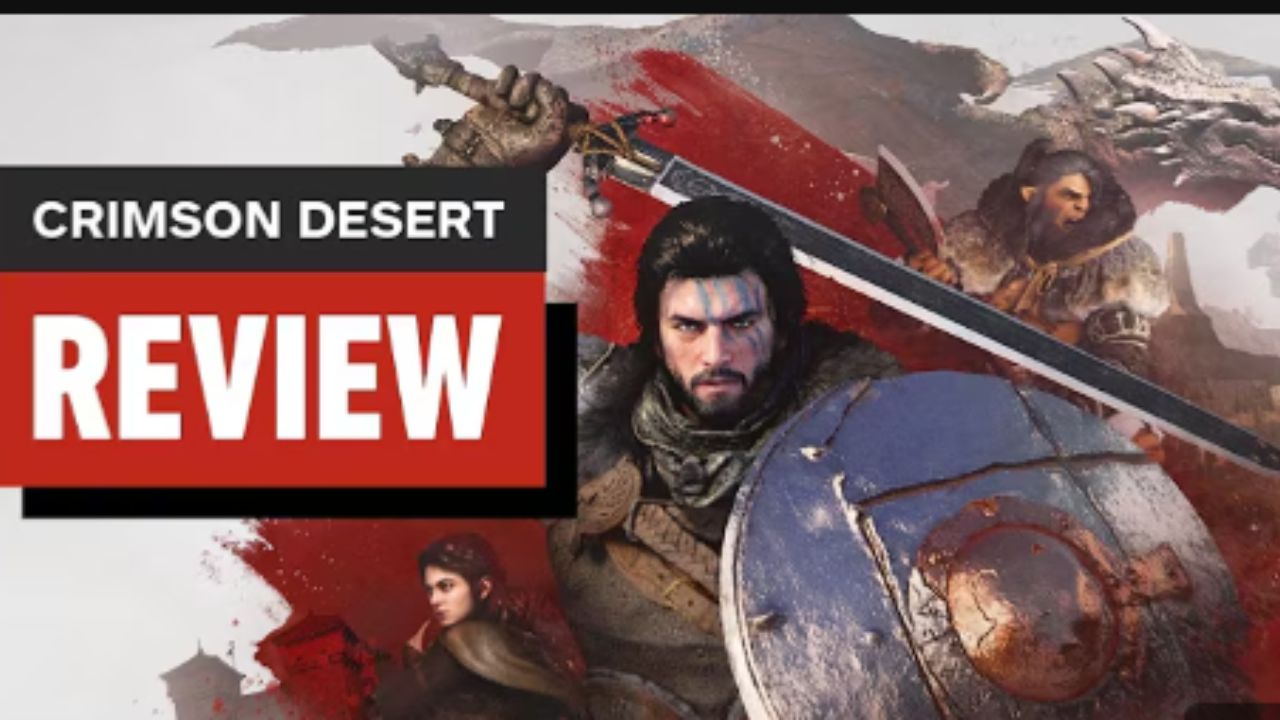
Crimson Desert Review 2026: Let’s be honest — when Crimson Desert trailers started rolling out through 2025, plenty of gamers had the same thought: this looks too good to be true. A massive open world bigger than Skyrim, physics-driven combat with wrestling moves, dragon riding, base building, Abyss magic, three playable characters — all from the studio behind the MMORPG Black Desert? Skepticism was understandable.
But Crimson Desert released on March 19, 2026, and after hundreds of combined hours across reviews from major outlets and real player feedback, the picture is becoming very clear. This game is not a disappointment — but it is a complicated one. Whether it earns a place in your library depends entirely on what kind of gamer you are. If you came for a tight, cinematic story like The Witcher 3, you may leave unsatisfied. But if open-world exploration, reactive combat, and the freedom to get completely lost in a world fires you up — Crimson Desert might genuinely be the biggest game of 2026.
Here is our full Crimson Desert review, covering everything from combat and story to world design, progression, and whether the final product lives up to the hype.
Crimson Desert Review 2026— Quick Overview
| Category | Details |
| Game | Crimson Desert |
| Developer | Pearl Abyss |
| Publisher | Pearl Abyss |
| Release Date | March 19, 2026 |
| Platforms | PC (Steam), PlayStation 5, Xbox Series X|S |
| Genre | Open-World Action-Adventure RPG |
| Key Features | Action Combat, Abyss Powers, Base Building, Dragon Riding, Physics Puzzles |
| Price | $69.99 USD |
Open World — A Continent That Demands Exploration
The world of Pywel is the undeniable star of Crimson Desert. Multiple reviews mention the exact same moment: standing at a sky-high location and watching the full scope of the map unfold beneath you. It is a genuinely jaw-dropping experience, and Pearl Abyss earned every bit of it.
How Big Is the Crimson Desert Map?
To put it plainly: enormous. The Crimson Desert map is estimated to be roughly twice the size of The Elder Scrolls V: Skyrim and reportedly even larger than Red Dead Redemption 2’s sprawling frontier. Even with a flying mount, traversing from one side to the other takes hours. The world packs in multiple distinct biomes — snowy tundras, desert oases, lush forests, floating sky islands, and more — each feeling genuinely distinct rather than reskinned variations of the same terrain.
Freedom From the Start
One of the smartest design choices Pearl Abyss made is giving players freedom almost immediately. Within the opening hours of the main story, you are cut loose to explore wherever you want. The map only shows location names for unvisited areas, which means those evocative names — Mistveil Forest, Mountain of Frozen Souls, Rattlesnake Steppe — draw you in before you even arrive. That sense of real discovery is rare in modern open-world games, and Crimson Desert nails it.
What You Can Do in the Open World
- Hunt bounty targets scattered across Pywel
- Gamble in parlour games including arm wrestling and rock-paper-scissors
- Race horses and trade goods based on fluctuating market prices
- Mine ore, chop trees, fish, and cook meals at bonfires
- Discover dynamic NPC relationship systems and bond with animals
- Interact with Abyss-linked locations that unlock fast travel and new pathways
The sheer variety of things to do is staggering. Some activities feel simple on their own, but together they create a world that feels genuinely alive rather than a checklist of icons on a map.
Combat System — Deep, Rewarding, and Sometimes Infuriating
Crimson Desert’s combat is the second biggest talking point across every review. The baseline description sounds simple enough — you’re a sword-swinging mercenary taking on human enemies and massive bosses. But the actual execution goes far deeper than that.
The Core Fighting Feel
Every hit has weight. Every move has purpose. You cannot button-mash your way through fights and expect to survive. The combat rewards timing, positioning, and creativity in ways that call back to the best action games on the market. You can chain fast strikes with slow, powerful slashes, and uniquely, you can grab enemies and throw them — even flinging NPCs into enemy camps to scatter them before diving headfirst into the chaos yourself. Environmental interactions are equally fun: vaulting over enemies, climbing larger foes to strike weak points, and chaining grabs into combo finishers makes every encounter feel different.
The Abyss Skill System
Beyond standard swordsmanship, Kliff gains magical abilities from the Abyss — a mysterious dimension powered by magic and technology. These powers are central to both combat and exploration. The Axiom Force ability, for example, begins as a grappling hook used for puzzle rotations, but with skill points invested, it becomes one of the game’s most versatile traversal and combat tools. Other powers let you make objects weightless, lift heavy obstacles, or deploy a glider to cover distances. The Abyss powers constantly evolve your gameplay toolkit the further you progress.
Combat Criticisms — What Holds It Back
No Crimson Desert review would be complete without acknowledging the frustrations. Early game combat is significantly less exciting before you unlock a substantial skill library. Execution animations — while cool individually — become tedious during large base takeovers involving 40+ enemies. Boss encounters are a genuine mixed bag: some are brilliant, challenging fights comparable to Elden Ring in design. Others are defined by massive, unavoidable hit areas, tiny damage windows, and arenas so small that a single wrong step triggers a forced return warning. The healing system, where Kliff can only recover by eating food cooked at bonfires, means boss fights drain your supplies fast and force long gathering trips before retrying.
With roughly 30 different attack button combinations to manage, later-game combat can also become chaotically hard to read. That said, players who push through the initial learning curve consistently report combat becoming one of the most rewarding experiences they have had in a modern action game.
Story and Characters — Ambitious Setup, Uneven Delivery
Who Is Kliff?
You play primarily as Kliff, a gruff, no-nonsense mercenary who leads the Greymanes — a warrior faction renowned for their swordsmanship and reputation for helping those in need. The story begins with a devastating ambush that scatters the Greymanes, and Kliff’s mission becomes one of rebuilding, reuniting, and uncovering what forces are working against him in the war-torn lands of Pywel. It is a solid premise for a medieval fantasy tale.
Where the Narrative Falls Short
The consensus across most reviews is consistent: Crimson Desert’s story is serviceable but not compelling. The early chapters in particular feel like a disjointed string of objectives rather than a coherent narrative. Quests often lack the connective tissue that makes you feel like a character embedded in a living world — you follow objectives because the quest log says so, not because the story earns your emotional investment. Story set pieces are genuinely impressive and the production quality is undeniable, but the moment-to-moment dialogue is frequently flat, and the main narrative leans on familiar fantasy tropes without subverting any of them.
That said, the broader world lore — the history of Pywel, the mystery of the Abyss, and the political tensions between factions — is genuinely interesting for players willing to seek it out. Crimson Desert rewards the curious.
Character Progression and Base Building
Three Playable Characters
Crimson Desert features three playable protagonists, each with their own unique skill trees that complement different playstyles. Kliff is the balanced fighter with versatile access to swords, polearms, and ranged options. The other characters deepen the combat variety further. Switching between them adds a welcome layer of strategic flexibility to both combat and exploration.
The Greymanes Base
One of the most satisfying long-term progression systems is rebuilding and expanding the Greymanes’ camp. This is not cosmetic base building — it has real impact on your gameplay. Workshops reduce gear upgrade times, armories give better combat preparation options, and farming and trading post structures improve your resource flow. You can also send allied Greymanes on supply and combat missions to earn materials and occasionally rare loot. Watching the base grow from scattered remnants into a functioning military camp as you progress through the story is genuinely rewarding.
Technical Performance and Visuals
On PC with capable hardware, Crimson Desert is a showcase title for Pearl Abyss’s proprietary BlackSpace Engine. The physics system is genuinely reactive — grass, water, and environments respond to your actions in ways that add immersion to every exploration session. On PS5 Pro with the PSSR upgrade, the game can target 4K resolution at higher frame rates with ray-traced lighting. The DualSense haptic implementation is notably good, with weapon clashes, parries, and heavy hits all registering through the controller in ways that enhance combat feedback.
Performance has been a topic in reviews, with some outlets noting crashes and bugs at launch. However, Pearl Abyss has been actively patching post-launch, with several reviewers and community members noting that the studio’s responsiveness has meaningfully improved the experience over the first week.
Crimson Desert Review Score Roundup
Here is how major publications scored Crimson Desert at and around launch:
| Publication | Score | Verdict |
| Vice | 5/5 | One of the most ambitious games since RDR2 |
| DualShockers | 9.5/10 | Absolute marvel, one of the best open-world games |
| Forbes | 9.5/10 | Outstanding post-launch support from Pearl Abyss |
| GamingTrend | 95/100 | Once-in-a-generation action RPG |
| Destructoid | 8.5/10 | Incredible foundations, minor polish issues |
| GamesRadar+ | 4/5 | Far better as a sandbox than a story |
| GameSpot | 7/10 | A world worth getting lost in |
| Game Informer | 7/10 | Special moments buried under excess |
| IGN | 6/10 | Ambitious but frustrating inventory & boss issues |
The wide range of scores reflects the game’s divisive nature. Reviewers who valued open-world freedom and sandbox discovery rated it highly. Those who prioritized narrative polish and quality-of-life refinement were more critical. The Metacritic average sits in the high-to-mid range — impressive for an ambitious new IP.
Pros and Cons
| Pros | Cons |
| Stunning open world — estimated 2x the size of Skyrim | Early game pacing is slow and tutorial-heavy |
| Deep, rewarding combat with 30+ attack combinations | Boss healing loop can feel like forced padding |
| Abyss powers add creative traversal and puzzle solutions | Narrative lacks connective tissue and compelling drama |
| Base building (Greymanes camp) adds meaningful progression | Limited fast travel makes long rides tedious |
| Three playable characters with distinct skill trees | Stealth mechanics feel underdeveloped |
| Physics-driven world interactions feel genuinely reactive | Inventory management needs further polish |
Beginner Tips for Crimson Desert
Survive the First Three Hours
Nearly every player review mentions the same thing: the opening hours are rough. Early quests are slow, systems feel overwhelming, and combat has not yet opened up. Push through this period. Once the world opens up and you start unlocking Abyss powers and combat abilities, the game transforms significantly.
Key Tips to Know Before You Start
- Cook food regularly at bonfires — this is your only healing method in boss encounters, so stockpiling is essential
- Explore Abyss-linked locations even if they seem optional — they unlock fast travel points and new traversal tools
- Invest skill points into Axiom Force early — it becomes a versatile grapple, puzzle-solver, and combat tool
- Do not skip the Greymanes base upgrades — structures provide tangible progression benefits, not just visual rewards
- Observe enemy combat moves carefully — Kliff can learn new skills by watching fighters in action, even during battle
- Manage your inventory proactively — leaving it full before boss encounters creates significant frustration
Expert Opinion — Who Is Crimson Desert For?
Crimson Desert is not a game for everyone, and understanding that before buying will save frustration. If you want a tightly crafted, story-first experience in the tradition of The Witcher 3 or God of War, this is not that game. The story is functional but not emotionally gripping, and the early pacing will test your patience.
But if what excites you is discovery — the feeling of cresting a hill and seeing something you did not expect, diving into a combat system that keeps revealing new layers, or getting absorbed into a world so large you cannot possibly see everything in a single playthrough — Crimson Desert delivers that experience at a scale that very few games have ever attempted. The comparison to Breath of the Wild is apt: both games prioritize the freedom to explore over the compulsion to complete. Pearl Abyss has built something genuinely rare here, and with active post-launch support already improving the experience, the trajectory is positive.
For fans of open-world sandbox games, action-RPG combat depth, and games that reward patience and curiosity, Crimson Desert earns a strong recommendation.
Frequently Asked Questions (FAQs)
Is Crimson Desert worth buying in 2026?
Yes, for open-world RPG fans. Crimson Desert delivers a massive, reactive world with deep combat and hundreds of hours of content. If you can push through the slow opening hours and do not need a compelling main narrative, it offers one of the most expansive gameplay experiences in recent memory.
What platforms is Crimson Desert available on?
Crimson Desert is available on PC via Steam, PlayStation 5, and Xbox Series X|S. The game launched on March 19, 2026. PS5 Pro users get a dedicated PSSR upgrade that enables higher framerates at 4K resolution.
How big is the Crimson Desert map?
The Crimson Desert map is estimated to be roughly twice the size of Skyrim and larger than Red Dead Redemption 2. The world includes multiple biomes including tundras, deserts, forests, and floating sky islands. Even with a flying mount, crossing the full map takes several hours.
Is Crimson Desert an MMO or single-player game?
Crimson Desert is a single-player action-RPG. It originated from an MMORPG project, but Pearl Abyss stripped out the online and MMO elements for this release. However, fans of Black Desert will notice some familiar mechanics in the progression and combat systems.
How does the combat system work in Crimson Desert?
Combat in Crimson Desert is a deep action system with over 30 attack combinations including light attacks, heavy strikes, grabs, throws, and magical Abyss abilities. The style is more rewarding than standard hack-and-slash, requiring timing, positioning, and combo creativity. Combat depth increases significantly as you unlock more skills.
What are Abyss powers in Crimson Desert?
Abyss powers are magical abilities Kliff gains by interacting with the Abyss dimension during the story. These include Axiom Force (a grappling hook that also manipulates objects), a glider, and the ability to turn objects weightless. These powers evolve as you invest skill points, becoming core tools for both combat and exploration.
Does Crimson Desert have a good story?
The consensus is mixed. Crimson Desert has an interesting world and lore, but the main narrative delivery is uneven. Early story chapters feel disjointed and objective-driven rather than character-driven. Set-piece moments are impressive, but moment-to-moment storytelling lacks polish compared to genre leaders like The Witcher 3.
What are the biggest issues with Crimson Desert?
The main criticisms are: slow early pacing, frustrating boss encounters tied to a food-based healing loop, limited fast travel in a very large world, inconsistent narrative quality, and an initially overwhelming number of complex systems. Many of these issues have been partially addressed through post-launch patches from Pearl Abyss.
Crimson Desert Map: Size, All Regions & Exploration Tips (2026)

Surya Gupta is a professional blogger and SEO specialist with over five years of experience in digital content creation. He writes about technology, smartphones, games, trading, and trending topics. Through his websites, he aims to provide clear, accurate, and helpful information to readers.