
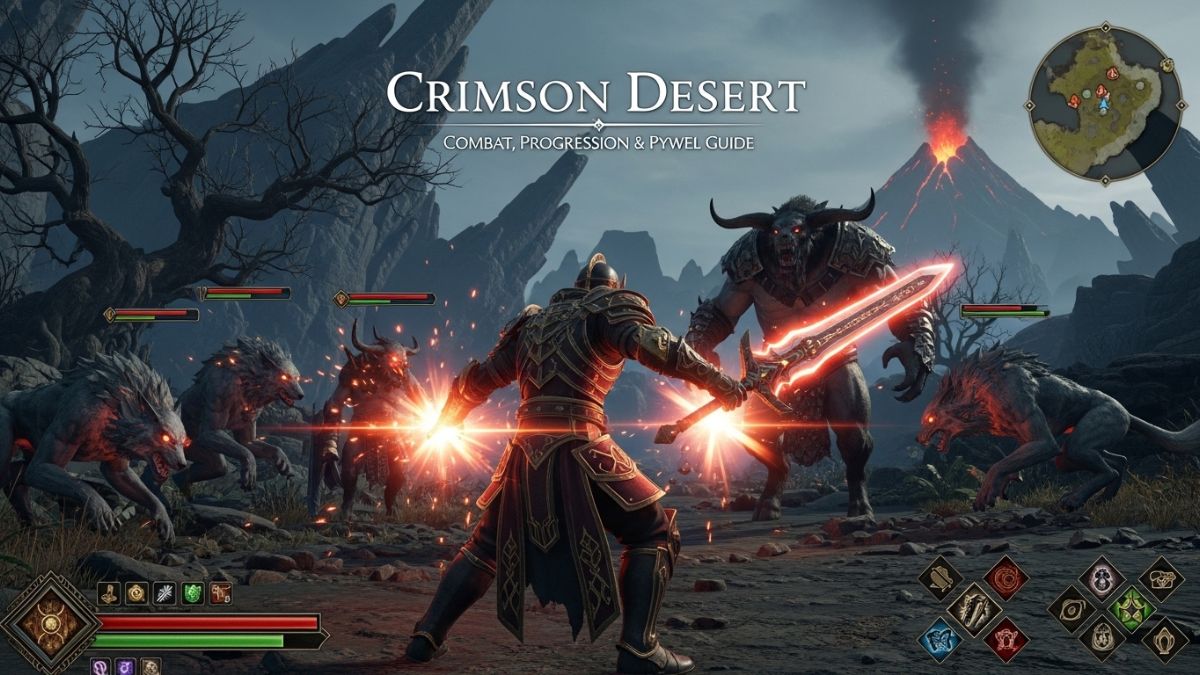
Crimson Desert Gameplay: When a game survives years of anticipation and still manages to raise the bar every time new footage drops, you know something genuinely special is being built. Crimson Desert gameplay has been turning heads since its earliest trailers — not just because it looks stunning, but because the systems underneath are surprisingly deep. Developed by Pearl Abyss, the studio behind Black Desert Online, this standalone single-player action-adventure is set in the war-torn continent of Pywel and follows Kliff, a mercenary leader trying to rebuild everything he has lost. With March 19, 2026 locked in as the release date and over two million Steam wishlists already counted, the question is no longer whether Crimson Desert will arrive — it is whether players are ready for what it brings. This guide breaks down everything you need to understand before stepping into Pywel.
Crimson Desert Gameplay Overview: What Kind of Game Is It?
Before diving into mechanics, it is important to settle one question that has circled gaming forums for years. Crimson Desert is not an MMO. It is not a traditional souls-like either. Pearl Abyss describes it as an open-world action-adventure game — a single-player experience where narrative and exploration carry as much weight as combat. The balance, as the PR Director confirmed, sits somewhere between The Witcher 3’s story richness and The Legend of Zelda: Breath of the Wild’s freedom to roam and experiment.
The game is set on the continent of Pywel, a seamless medieval fantasy world divided into five distinct regions: Hernand, Pailune, Demeniss, Delesyia, and the Crimson Desert itself. Each region has its own culture, climate, and dangers. No loading screens interrupt your journey from a snowfield to a burning desert. The world is reportedly larger than Red Dead Redemption 2’s map, with dynamic weather, full day-night cycles, and NPCs that maintain their own routines regardless of where Kliff stands.
The main campaign tells only a fraction of the full story. Side content, exploration, and optional encounters fill out the rest — meaning players who rush through will experience a very different game than those who take their time. This is intentional design, not padding.
Crimson Desert Combat System: Fluid, Physical, and Deeply Creative
The combat in Crimson Desert gameplay is the centrepiece that most previews have rightly focused on. Pearl Abyss built a system around one guiding idea: there is no single correct way to win a fight. Enemy encounters shift based on terrain, elevation, mount availability, and the weapons you happen to be carrying. What works against a cavalry charge may fall apart inside a narrow dungeon corridor, and the game expects you to adapt.
Weapon Arsenal and Weapon Switching
Players can carry multiple weapon types and switch between them fluidly during combat. The current confirmed arsenal includes sword and shield, spear, greatsword, twin blades, axe, and several ranged options. Each weapon is not just a different skin — they alter your movement speed, attack reach, combo potential, and the kinds of enemies you can crowd-control or stagger. A greatsword demolishes armoured soldiers but leaves you slow against fast, mobile creatures. A spear keeps enemies at distance but struggles in tight rooms. Choosing your loadout before engaging is already half the battle.
Combos, Grapples, and the Unexpected Wrestling Element
What separates Crimson Desert from many action-RPGs is that unarmed combat is not an afterthought. Kliff can chain weapon strikes directly into kicks, throws, and full grapple sequences. The grapple system is unusually detailed — players can drag mounted enemies off their horses, steal those mounts mid-fight, and immediately use them to trample remaining opponents. One of the more unexpected and genuinely exciting revelations from the combat overview video was that the grapple animations include recognisable wrestling moves: German suplexes, chokeslams, and even an Angle Slam. It sounds ridiculous on paper. In motion, it looks phenomenal.
Elemental Enhancement and Timing-Based Counters
Most attacks in Crimson Desert can be infused with elemental effects — fire, ice, and additional elements yet to be fully revealed. This is not a separate magic system layered on top of physical combat; elemental enhancement is integrated directly into your weapon skills, meaning a spear thrust can become a freezing stab with the right ability equipped. This creates a tactical puzzle on top of the action: fire works against ice-type enemies, ice can lock down fast opponents, and certain bosses resist elements entirely, forcing you to think rather than spam.
Timing sits at the heart of the defensive game. Precise guards and evasions open counterattack windows. Miss the timing and you eat full damage. Land it correctly and the fight shifts decisively in your favour. This is where Crimson Desert earns its difficulty — not through punishing stamina systems like a souls-like, but through demanding genuine situational awareness.
Progression System: Artifacts, Abyss Fragments, and No Level Grinding
One of the most refreshing design decisions in Crimson Desert gameplay is how the studio handles character growth. There are no traditional experience points. There is no grind-a-dungeon-fifty-times loop. Instead, progression is tied to what you actually do in the world.
The Artifact System Explained
Core stat increases — health, stamina, damage output — come from collecting Abyss fragments. These fragments are earned by defeating powerful bosses, completing quests, and exploring hidden corners of Pywel. The Artifact system converts these fragments into permanent upgrades. The result is that every meaningful fight or discovery moves your character forward, rather than requiring repetitive farming between story beats.
Skill Books and Equipment Upgrades
Beyond the Artifact system, Kliff can learn new combat techniques through skill books found in the world or purchased from vendors. Weapons and armour can be upgraded at Blacksmiths using materials gathered through mining, boss drops, and quests. This creates a satisfying loop without the monotony of level-grinding: explore more, discover more, grow stronger in ways that feel earned rather than mechanical.
Three Playable Characters: Kliff Is Not Alone
A detail that surprised many when it was revealed: Crimson Desert is not strictly a one-protagonist game. While Kliff is the primary lead, two additional playable characters join the Greymanes roster, each with a distinct combat identity.
- Kliff — The core protagonist. A versatile warrior capable of wielding most weapon types. His progression arc drives the main narrative as he rebuilds the Greymanes after the Black Bears’ ambush.
- Agile Female Warrior — Described as using magic, a greatsword, and a pistol. Her combat style emphasises speed, ranged capability, and elemental attacks, making her the mobility-focused option.
- Orc Barbarian — A large, powerful character wielding a greataxe and an arm cannon, with a pickaxe for mining. His role leans toward raw damage and resource gathering, fitting naturally into the game’s crafting systems.
Whether the story fully integrates these characters or whether they serve primarily as gameplay alternatives remains to be seen at launch. However, their presence suggests replayability and variety that goes well beyond a single protagonist experience.
How Crimson Desert Gameplay Compares to Similar Titles
| Feature | Crimson Desert | The Witcher 3 | Dragon’s Dogma 2 |
| Combat Style | Combo + Grapple + Elemental | Signs + Sword + Bombs | Vocation-based class system |
| Progression | Artifact / Exploration-driven | XP + Level up | XP + Vocation Points |
| World Size | Larger than RDR2 | Large, region-based | Large, seamless |
| Multiplayer | Single-player only | Single-player only | Single-player only |
| Difficulty | One setting — skill-rewarding | Multiple options | Fixed, challenging |
Exploration and Non-Combat Activities in Pywel
Not every hour in Crimson Desert will be spent fighting. Pearl Abyss has built a living world with genuine breadth beyond combat encounters. For players who want a break from intense boss battles, the options are extensive.
- Fishing — Available at water sources throughout Pywel, with dedicated mechanics rather than a simple prompt
- Farming and Camp Management — Players can build and upgrade a customisable Greymanes base, growing resources and managing operations
- Cooking — Recipes are discovered and crafted using gathered ingredients
- Hunting — Wildlife in Pywel can be tracked and hunted for crafting materials
- Underground Fight Clubs — Optional combat arenas for players who want to test their skills against unique opponents
- Eavesdropping for Quests — Overhearing NPC conversations can unlock hidden quest lines
- Puzzle Exploration — Themed environmental puzzles reward attentive players who look beyond the obvious path
Mounts are equally diverse. Horses remain the default traversal option, but players can also ride bears, wolves, and at certain story points, dragons. Giant rideable mechs were revealed in the story overview video, adding yet another layer of unexpectedness to an already ambitious game.
Pros and Cons of Crimson Desert Gameplay
What Works in Crimson Desert’s Favour
- Combat system is genuinely innovative — the grapple and elemental systems add layers most action-RPGs skip entirely
- Exploration-driven progression removes the fatigue of traditional grinding
- World size and environmental variety rival or exceed current genre benchmarks
- Three playable characters provide replayability and distinct combat experiences
- Available on PS5, Xbox Series X/S, PC (Steam and Epic), and Mac — one of the broader launch windows in recent memory
- Main campaign intentionally represents only a fraction of total content
Where Players Should Adjust Expectations
- A single difficulty setting means players who want accessibility options may find frustration before they find mastery
- Complex button combinations have drawn mixed feedback from preview hands-on sessions — the learning curve is real
- No multiplayer: players who prefer co-op open worlds will not find that here
- Ambitious open-world games carry launch optimisation risk — performance on PC at release day is always an unknown
Expert Opinion: What Gaming Critics Noted After Hands-On Time
Across multiple preview outlets following the Gamescom 2024 demo and the February 2026 Features Overview videos, a few consistent observations emerged from journalists who have actually played portions of the game.
Writers at Altchar described the combat as rewarding creativity above all else, noting that the environmental interaction system — using terrain as a weapon during large encounters — elevated fights beyond button-combo execution. Windows Central noted that the combat feels like a thoughtful blend of Monster Hunter’s physicality and The Witcher 3’s narrative weight, two games rarely mentioned in the same breath, yet somehow both accurate here. Wccftech’s coverage highlighted the Artifact progression system specifically, calling it the most meaningful departure from traditional RPG levelling they had seen in years — because every upgrade genuinely reflected something the player had accomplished.
The consistent concern from previews was not about the game itself but about launch readiness. One comparison raised repeatedly was Monster Hunter Wilds, an ambitious title that launched with significant PC performance issues. Whether Pearl Abyss has avoided that pitfall remains the single largest unanswered question heading into March 19.
5 Practical Tips to Get the Most Out of Crimson Desert on Day One
- Learn the parry window before taking on named enemies. Crimson Desert rewards precise timing far more than raw aggression. Spend the early hours practising counter windows against weaker opponents before the difficulty spikes.
- Experiment with all weapon types in the early game. Since there are no class restrictions, your combat identity will emerge naturally once you understand how each weapon behaves across different enemy types.
- Prioritise Abyss fragment collection on your first run through any region. Fragments from bosses and hidden locations are finite on a first pass, and missing them early delays your stat growth.
- Invest time in camp management between major story beats. The Greymanes base provides passive resource generation that compounds over a long playthrough.
- Switch playable characters deliberately, not randomly. Each character’s strengths align differently with certain enemy types, and experimenting with character swaps during difficult encounters can shift the outcome entirely.
Crimson Desert Release Date, Platforms, and Editions
Crimson Desert releases on March 19, 2026, simultaneously across all platforms. The game went gold in January 2026, meaning no further delays are expected. Supported platforms at launch are PlayStation 5, Xbox Series X/S, PC via Steam and Epic Games Store, and macOS.
Four editions are currently available for pre-purchase. Standard, Deluxe, Special, and Collector’s editions are offered both digitally and physically. All pre-purchase orders receive the exclusive Khaled Shield item. The Deluxe Edition adds gear for Kliff and his horse. The Collector’s Edition includes a hand-painted 17-inch diorama of Kliff, the most premium physical option Pearl Abyss has produced for any of its titles.
Black Desert Online players also receive crossover bonuses, acknowledging the shared universe without requiring any prior knowledge of the MMO to enjoy Crimson Desert.
Conclusion: Is Crimson Desert Worth Your Time in 2026?
Everything about Crimson Desert gameplay suggests Pearl Abyss has built something with genuine ambition at every level — not the kind of ambition that announces big numbers and delivers shallow content, but the kind that rethinks how systems connect with each other. A progression system that never makes you grind. Combat that rewards creativity over memorisation. A world large enough to lose yourself in for months, with enough variety that losing yourself never gets boring.
The risks are real. Single-difficulty design will frustrate some players. PC launch performance is an open question. But if the promise holds, Crimson Desert will be one of those rare titles people still talk about years after release — not just because it was massive, but because it was genuinely thoughtful. Wishlist it now. Pre-purchase if you are committed. And set aside a serious block of time from March 19, because Pywel will not wait.
Frequently Asked Questions (FAQs)
1. What type of game is Crimson Desert?
Crimson Desert is a single-player open-world action-adventure game developed by Pearl Abyss. It is not an MMO and not a traditional souls-like. The gameplay balance sits between The Witcher 3’s story depth and Breath of the Wild’s exploration freedom, with a proprietary combat system built around combos, grapples, and elemental attacks.
2. How does Crimson Desert’s combat system work?
Combat in Crimson Desert allows players to combine weapon strikes, unarmed attacks, kicks, and grapples into fluid combo chains. Weapons can be enhanced with elemental effects like fire and ice. Enemies react to terrain and player positioning, and timed parries open counterattack windows. There are no class restrictions — players choose and combine weapons freely.
3. How does character progression work in Crimson Desert?
Progression uses the Artifact System rather than traditional XP. Players collect Abyss fragments by defeating bosses, completing quests, and exploring Pywel. These fragments unlock permanent stat increases like health and stamina. New combat skills come from Skill Books found in the world, and equipment is upgraded using materials gathered through mining and exploration.
4. How many playable characters are in Crimson Desert?
There are three playable characters. Kliff is the primary protagonist and the most versatile. The second is an agile female warrior who uses magic, a greatsword, and a pistol. The third is a large orc barbarian wielding a greataxe, an arm cannon, and a pickaxe. Each plays differently and has a unique role in combat and exploration.
5. Is Crimson Desert a souls-like game?
No. While Crimson Desert features precise timing mechanics and challenging boss fights, it does not use stamina depletion, harsh death penalties, or the minimalist narrative style associated with souls-like games. It is more comparable to God of War or The Witcher 3 in terms of overall design philosophy.
6. What platforms is Crimson Desert available on?
Crimson Desert launches on March 19, 2026 for PlayStation 5, Xbox Series X/S, PC via Steam and Epic Games Store, and macOS. There is no confirmed Switch 2 version or last-generation console support at launch.
7. Does Crimson Desert have multiplayer?
No. Crimson Desert is a fully single-player experience. Pearl Abyss has not announced any multiplayer mode or cooperative functionality. The game is designed entirely around solo play and narrative immersion.
8. What non-combat activities are available in Crimson Desert?
Beyond fighting, players can engage in fishing, farming, cooking, hunting, base management for the Greymanes camp, underground fight clubs, environmental puzzle exploration, and eavesdropping to discover hidden quests. A variety of mounts are available including horses, bears, wolves, and at certain points dragons and rideable mechs.
Crimson Desert Collector’s Edition: Is It Worth It?

Surya Gupta is a professional blogger and SEO specialist with over five years of experience in digital content creation. He writes about technology, smartphones, games, trading, and trending topics. Through his websites, he aims to provide clear, accurate, and helpful information to readers.