
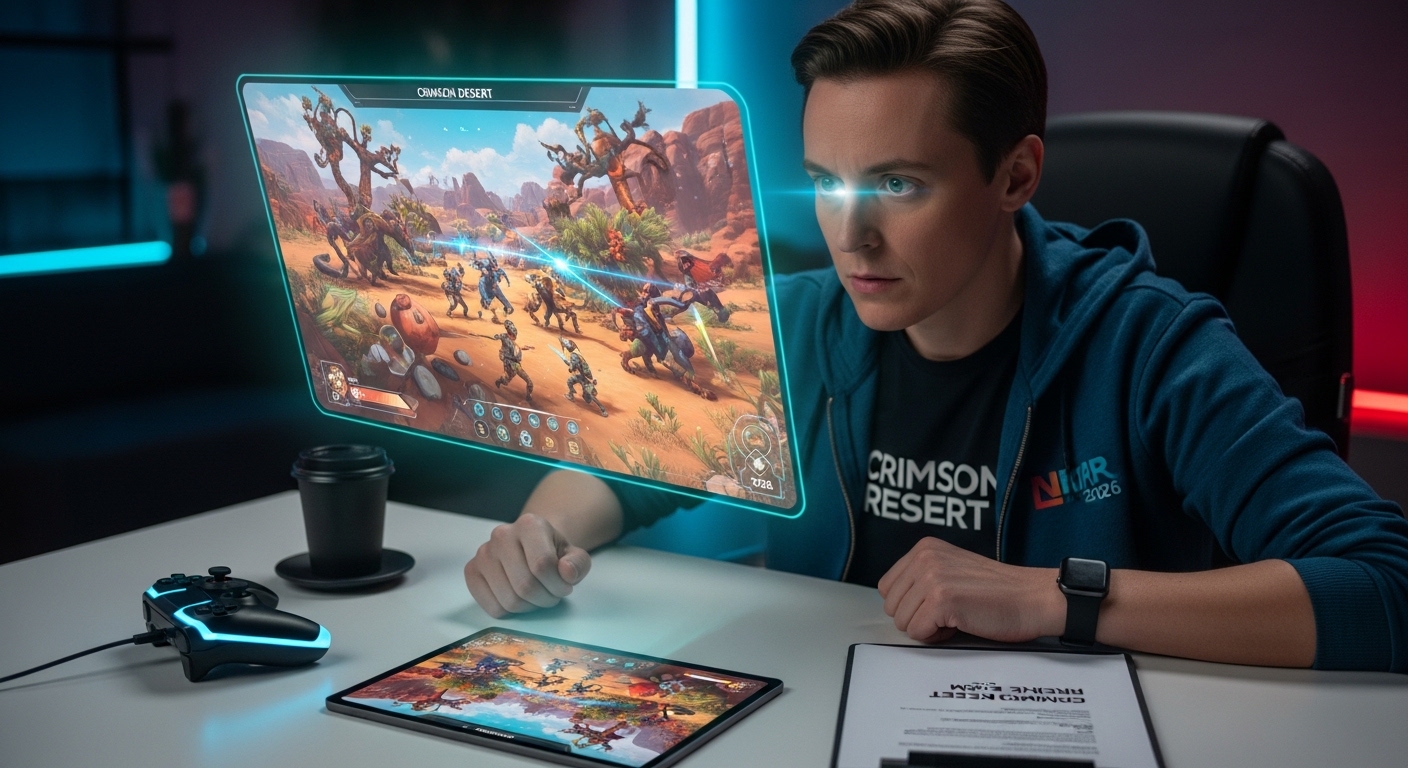
Crimson Desert Review 2026: Six years. That’s how long gamers have been holding their breath. Since that jaw-dropping debut trailer dropped at The Game Awards 2020, Crimson Desert has lived rent-free in the heads of every open-world RPG fan on the planet. Stunning visuals, cinematic boss fights, a hero riding a bear — it looked almost too good to be real. And every year, the whisper got louder: “Is this game actually going to come out, or is it vaporware?” Well, March 19, 2026 answered that question definitively. Crimson Desert, the standalone single-player action-adventure from Pearl Abyss, released on March 19, 2026 for PS5, Xbox Series X/S, PC via Steam, and macOS. The Crimson Desert review conversation has officially begun — and what critics and players are saying is far more interesting than anyone expected.
What Is Crimson Desert? The Full Picture
Before diving into whether it’s good, let’s set the stage for those who’ve been living under a rock. Crimson Desert is set in the open-world fictional continent of Pywel, a medieval fantasy world gripped by multiple conflicts and mysterious forces. Players control Kliff, a member of the Greymanes mercenary company, as he navigates a world populated by rival factions, mythical creatures, and arcane forces.
The game was first announced in 2019, and since then has gone through extensive development. Initially teased as a prequel to Black Desert Online, it later evolved into a completely standalone title — meaning new players can jump straight in without any prior knowledge of the MMO.
What makes this particularly significant is context. Pearl Abyss has spent over a decade running Black Desert Online — a game packed with microtransactions and monetization systems. Many fans were understandably nervous that Crimson Desert would follow the same path. It didn’t.
A Premium Game With Zero Microtransactions
This deserves its own spotlight because in 2026, it’s genuinely rare. Pearl Abyss confirmed that Crimson Desert will not feature any microtransactions when it launches on March 19, outside of its preorder bonuses. PR and marketing director Will Powers stated: “This is made to be a premium experience that you buy and enjoy the world, and not something for microtransactions.”
There is no cosmetic cash shop. Pre-order and deluxe edition bonuses are limited to a new shield and, for the deluxe pack, some plate armour and a horse tack — that’s it.
The game launches with three editions: Standard at $69.99, Deluxe Edition at $89.99, and Collector’s Edition at $279.99, which includes physical collectibles and more.
In an era where Dragon’s Dogma 2 got roasted for microtransactions and live-service games dominate every storefront, this is a genuinely gamer-friendly move — and it’s converted a lot of fence-sitters into buyers.
Crimson Desert Review: The Story and World
The Greymanes — A Story Worth Caring About
A devastating ambush in the deep of night by their sworn enemies the Black Bears leaves members of the Greymanes dead or scattered across the continent. Kliff is determined to reunite with his surviving comrades and rebuild what was lost. But on a journey where alliances are forged, dangers abound, and mysterious factions are uncovered, Kliff comes to realize that an unprecedented threat and a destiny greater than he imagined awaits him.
It’s a tight, personal hook — a mercenary leader trying to pick up the pieces after everything falls apart. Pearl Abyss PR Director Will Powers confirmed that the main campaign is only a small percentage of the overall content available, and the balance between narrative and gameplay sits somewhere between The Witcher 3 and The Legend of Zelda: Breath of the Wild.
That’s an ambitious statement. But based on previews and hands-on impressions, it might actually be accurate.
Pywel — A World That Feels Alive
The map of Crimson Desert has been named Pywel, and it is absolutely massive and diverse — from towering mountain ranges to extremely busy medieval cities. Pearl Abyss has seemingly managed to make the map one of its strongest elements, thanks to the addition of meaningful areas to explore instead of just an empty, scaled-up landscape made for the sake of it.
The world is divided into regions like Hernand, rich with mountains and rivers and the starting point for players, and Pailune, the northernmost region and Kliff’s homeland. The day-night cycle and dynamic weather affect gameplay, influencing NPC behavior, quest availability, and environmental hazards.
Beyond the main story, players can engage in life skills such as fishing, hunting, and farming. Hunting mechanics even include wearing ghillie suits for camouflage and using bows to track wildlife.
The open world features bustling towns, quiet hamlets, vast plains, deserts, mountains, and forgotten ruins. Players can ride various mounts — from horses to wolves, and even a dragon and mechanical creatures — scale cliffsides, glide through the air, and enter mystical gates leading to the mysterious realm known as the Abyss.
Combat System: The Real Reason People Are Hyped
If there’s one thing that’s consistently blown people away in every preview and demo, it’s Crimson Desert’s combat. It doesn’t feel like anything else on the market right now.
Weapons, Combos, and Pure Chaos
Players can wield a wide arsenal of weapons including sword and shield, spear, greatsword, axe, and several ranged weapons, each offering distinct strengths and combat tactics. Weapons can be purchased, discovered through exploration, given as a reward for dispatching bosses and questlines, or crafted directly by the player.
Weapons can be switched on the fly. One combat sequence shows how you can suplex an enemy and then fire a magical beam of lightning on another before switching to a musket. You can fight entirely with hand-to-hand combat — punch, kick, and grapple in chaotic battles.
Kliff’s fighting style mixes swordplay, martial arts, magical acrobatics, and elemental palm techniques, making him feel like five different character classes all at once. You can change your equipped element on the fly, imbuing Kliff with fire, ice, or lightning — each effective against the endless hordes of enemies in different ways.
Environmental Combat and Enemy AI
Combat encounters in Crimson Desert are designed to remain unpredictable. Enemies react to player actions and can be influenced by terrain, elevation, and environmental objects. Players can take advantage of their surroundings during fights, turning the battlefield itself into a tactical tool, particularly during larger enemy encounters and boss battles.
There’s a fighting game quality to combat, especially in the way that directional inputs influence actions. For example, there’s a button to throw enemies, but there’s actually half a dozen different ways to throw an enemy, depending on the direction you press and the buttons you press immediately after.
No Easy Mode — Fixed Difficulty
Unlike most Soulslikes that lean into providing a difficulty setting toggle to make their game more accessible to a wider audience, this is not the case with Crimson Desert — the game reportedly features a fixed difficulty setting with no easy or hard mode to toggle.
This is a bold decision. It will frustrate casual players, but it signals Pearl Abyss is serious about the integrity of the experience.
Three Playable Characters: A Big Surprise
Most people assumed Crimson Desert would be a single-character game. Pearl Abyss surprised everyone.
Crimson Desert delivers three distinct playable characters instead of traditional class selection. Kliff anchors the main story as your versatile all-rounder, while Damiane and Oongka provide alternative playstyles for exploration and side content. Everyone starts with Kliff — he’s the only character available initially. Damiane and Oongka are unlocked by progressing through the main story, after which players can switch between characters to explore Pywel’s open world freely and complete side quests with alternative heroes. X
Here’s how each character breaks down:
- Kliff — The main protagonist. Most flexible weapon selection, balanced playstyle. Best for players who want options in every situation
- Damiane — High-risk, high-reward. Deals massive damage but is more vulnerable, rewarding skillful dodging and aggressive play
- Oongka — Raw power, easy-to-learn combos. Think barbarian energy. Perfect for beginners who want to obliterate enemy groups without memorizing complex chains
Progression System: No XP Grinding Here
This is where Crimson Desert really separates itself from genre conventions.
Crimson Desert replaces experience-point leveling with an artifact-based progression system. Players do not gain levels by defeating enemies. Instead, character growth centers on collecting Abyss Artifacts scattered throughout the continent of Pywel. These artifacts unlock skill enhancements and stat increases when acquired from sealed monuments or hidden locations.
At the heart of the system, Abyss fragments collected from quests, boss victories, and exploration unlock core stat boosts like Health and Stamina increases. These fragments also grant new skills that extend combo chains and enhance existing abilities. In a nice twist, some advanced techniques require players to observe them firsthand in the world before they can be learned.
Each player will most likely build a completely different version of Kliff. They might prioritize stamina upgrades to enable longer exploration sessions and extended gliding across Pywel’s vast regions, or focus on unlocking diverse grappling techniques to dominate melee combat. The skill combination system and upgrade paths are designed to reflect individual playstyles, ensuring no two players’ Kliff will develop identically.
Camp Management System — More Than a Side Feature
Beyond combat, Crimson Desert introduces a camp management system that might just be one of the best features for certain players. As Kliff, you can start and be part of Greymane’s camps in-game. This is not just a side activity — it is a full-fledged mechanic that asks you to invest time in building, structuring, and managing all the resources required for your camp. You can also recruit and send members on expedition missions.
There is also a full reputation system tied to regional factions. Completing quests or activities for a faction increases standing, unlocking new vendors, quests, and story branches. Players can even commit crimes — theft triggers a red “Crime: Theft” overlay and a Bounty Notice in the top-right corner.
Graphics: The BlackSpace Engine Is Genuinely Something Else
The game features a dynamic combat system powered by the proprietary BlackSpace Engine, which Pearl Abyss developed specifically for Crimson Desert.
Digital Foundry’s Alex Battaglia evaluated the graphics and praised the ray-traced reflections, especially noticeable in standing water. Regarding the interiors with marble floors, Battaglia noted that both diffuse RTGI and ray-traced reflections create an impressively realistic effect, saying the result is “quite comparable, and in some places even surpasses the Lumen GI technology in Unreal Engine 5.” A PC with an AMD 7900 XTX provides native 4K resolution at a target frequency of 60 frames per second.
Even with a full-scale war unfolding across the map, mobs of NPCs battling in the fields, and fiery explosions in the air, the game hits a level of performance and fidelity unlike anything seen before. The only flaw visible in preview builds was frequent NPC pop-in when approaching large groups while moving quickly on horseback — noticeable, but the only thing that ever broke immersion.
For maximum settings on PC, the BlackSpace Engine will require an RTX 5090 with full path tracing support. The implementation of NVIDIA DLSS 4.5 is mandatory for running maximum path tracing without dropping frames.
Crimson Desert Review 2026: Crimson Desert Pros and Cons
Pros
- Stunning visuals powered by the BlackSpace Engine — arguably the best-looking open-world game at launch
- Zero microtransactions — a premium, complete experience for your money
- Three playable characters with genuinely different combat styles
- No XP grinding — progression tied to exploration and artifact collection
- Unlimited open world with meaningful side content, life skills, and faction systems
- No time-limit pressure; explore at your own pace
- Simultaneous launch on PS5, Xbox Series X/S, PC, and macOS — nobody left behind
- Camp management and reputation systems add depth beyond combat
Cons
- Fixed difficulty — no easy mode will frustrate casual players
- Extremely demanding on PC hardware — full path tracing needs an RTX 5090
- Some NPC pop-in issues reported in preview builds at high speeds
- Main campaign is reportedly a fraction of total content — story lovers may want more
- Console performance details remain limited ahead of launch
- Six-year development journey means expectations are astronomically high — inevitable disappointment for some
Expert Verdict: Is Crimson Desert Worth Buying in 2026?
From hands-on preview sessions at Summer Game Fest, one writer stated: “I’m wildly impressed by every aspect of Crimson Desert, and while I can’t say yet if all of it adds up to a game I’ll actually want to play, I enjoyed the extravagance of it all. If nothing else, Crimson Desert is a spectacle — one that has to be seen to be believed.”
GamesRadar noted that since it was first revealed in 2019, Crimson Desert has looked almost too good to be true — a convincing hybrid of The Witcher-style dark fantasy and a massive variety of open-world action. We were promised a world bigger than Skyrim and Red Dead Redemption 2.
Whether it fully delivers on that promise is a question only playing it can answer. What’s undeniable is that the ambition is real, the technology is staggering, and the decision to launch as a fully premium, no-microtransaction experience is exactly what the industry needed in 2026.
If you love open-world RPGs, action combat, and exploring worlds with genuine depth — this is the game you’ve been waiting six years for.
Frequently Asked Questions (FAQs)
Q1. What is Crimson Desert and when did it release? Crimson Desert is an open-world action-adventure game developed and published by Pearl Abyss, set on the brutal continent of Pywel. It released on March 19, 2026, for PC, PS5, Xbox Series X/S, and macOS.
Q2. Is Crimson Desert related to Black Desert Online? The game was originally developed as a prequel to Black Desert Online but later evolved into a completely standalone single-player title. New players can jump in without any prior knowledge of the MMO.
Q3. Does Crimson Desert have microtransactions? No. Pearl Abyss confirmed Crimson Desert will not feature any microtransactions at launch. Will Powers stated: “This is made to be a premium experience that you buy and enjoy the world, and not something for microtransactions.”
Q4. How much does Crimson Desert cost? Crimson Desert launches in three editions: Standard at $69.99, Deluxe Edition at $89.99, and Collector’s Edition at $279.99, which features physical collectibles.
Q5. How many playable characters are in Crimson Desert? There are three playable characters: Kliff, who is available from the start and serves as the main protagonist; Damiane, a high-damage agile fighter; and Oongka, a raw power brawler. Damiane and Oongka are unlocked by progressing through the main story. X
Q6. Does Crimson Desert have an easy mode or difficulty settings? No. Crimson Desert features a fixed difficulty setting with no easy or hard mode toggle, similar to FromSoftware’s approach with Soulslikes.
Q7. What engine does Crimson Desert run on? Crimson Desert runs on Pearl Abyss’s proprietary BlackSpace Engine, which was originally built for Black Desert Online and significantly upgraded for this release. It supports full path tracing and ray-traced global illumination.
Q8. What is the progression system in Crimson Desert? Crimson Desert replaces traditional XP leveling with an artifact-based progression system. Players collect Abyss Artifacts from boss fights, quests, and exploration to unlock stat increases and new skills — no enemy grinding required.

Surya Gupta is a professional blogger and SEO specialist with over five years of experience in digital content creation. He writes about technology, smartphones, games, trading, and trending topics. Through his websites, he aims to provide clear, accurate, and helpful information to readers.