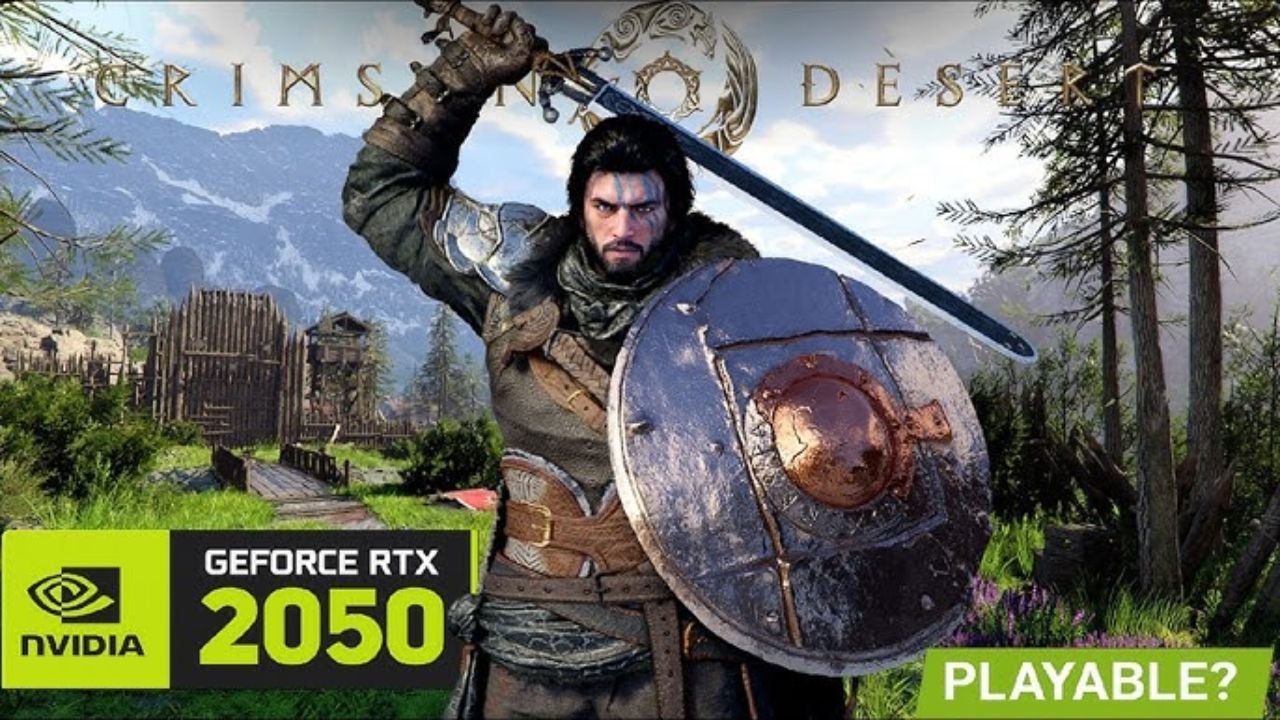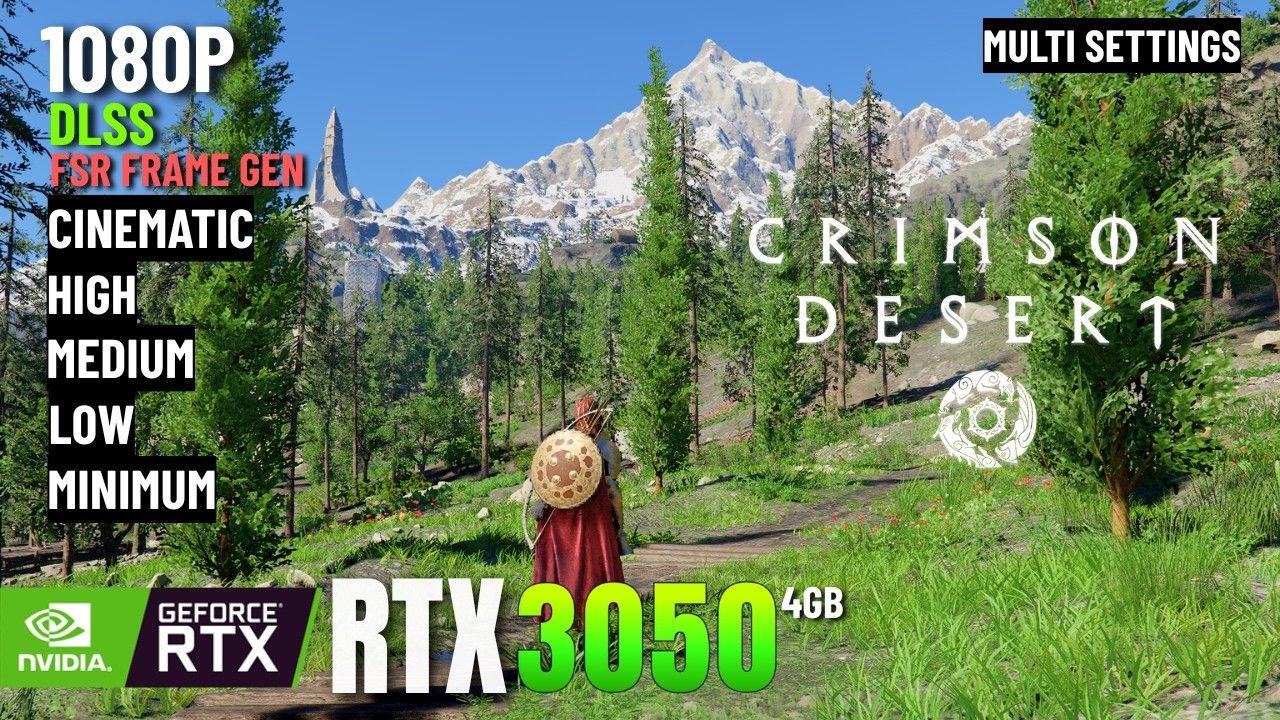
Crimson Desert RTX 3050 Laptop: So you’ve just launched Crimson Desert on your RTX 3050 laptop and you’re staring at a stuttering mess — or maybe you haven’t bought it yet and you’re wondering whether your machine can even handle it. Either way, you’re in the right place. Crimson Desert is easily one of the best-looking open-world action RPGs to drop in 2025, and Pearl Abyss built it on their proprietary Blackspace Engine — not Unreal Engine 5, which is actually an important distinction for performance. The RTX 3050 laptop GPU is not a powerhouse, but it’s far from hopeless here. With the right settings and a few smart tweaks, you can absolutely get a playable, enjoyable experience out of Crimson Desert on budget laptop hardware. This guide breaks down real FPS numbers, the actual settings that matter, and the laptop-specific optimizations that most generic guides completely skip over.
Crimson Desert RTX 3050 Laptop: Quick Game Overview
| Detail | Info |
|---|---|
| Game | Crimson Desert |
| Developer | Pearl Abyss |
| Publisher | Pearl Abyss |
| Release Date | March 19, 2026 |
| Platforms | PC, PS5, Xbox Series X/S |
| Genre | Open-World Action RPG |
| Engine | Blackspace Engine (Pearl Abyss proprietary) |
| Key Features | Single-player campaign, open world, fluid combat, dynamic weather, destruction physics |
| API | DirectX 12 |
| Upscaling Support | NVIDIA DLSS 4.5, AMD FSR 3.1 |
What to Expect Running Crimson Desert on an RTX 3050 Laptop
Let’s be straight with you: the RTX 3050 laptop GPU is sitting at the very bottom of the “playable” tier for Crimson Desert. Pearl Abyss officially lists it among cards that require low-to-medium settings and upscaling to potentially hit 60 FPS. That said, the game is genuinely well-optimized and scales impressively across hardware generations — which works in your favour.
At stock 1080p with the Cinematic (maximum) preset and zero upscaling, you’re looking at roughly 25–30 FPS on the laptop variant of the RTX 3050. That’s due to the TDP-limited nature of laptop GPUs — even the desktop RTX 3050 only hits around 30 FPS at Cinematic settings, so the mobile version with its thermal constraints naturally sits a bit lower.
The good news? That’s not how you should be running this game. With the right preset adjustments and FSR or DLSS enabled, getting a consistent 45–55 FPS at 1080p is realistic. And for gamers who are comfortable with 30 FPS, you’ll have visual headroom to spare.
Why This Matters for Laptop Gamers Specifically
Desktop benchmark sites test RTX 3050 performance under ideal conditions — plugged in, with full TDP, on a cool test bench. Your laptop situation is different. Thermal throttling, battery power modes, and background processes all eat into your real-world performance. A laptop RTX 3050 can perform 10–20% below a desktop 3050 in sustained workloads if your cooling isn’t doing its job properly. Keep that in mind as we go through the numbers.
Real FPS Numbers: Crimson Desert RTX 3050 Laptop
| Preset | Resolution | Upscaling | Estimated FPS |
|---|---|---|---|
| Cinematic | 1080p Native | Off | 25–30 FPS |
| Medium | 1080p Native | Off | 38–48 FPS |
| Low | 1080p Native | Off | 45–55 FPS |
| Low | 1080p | FSR Quality | 50–60 FPS |
| Medium | 1080p | FSR Balanced | 45–55 FPS |
| Low | 720p | FSR Quality → 1080p | 60–70 FPS |
Figures assume standard 80–95W TDP, modern mid-range CPU, 16GB RAM, game on SSD. Actual results vary by laptop model and thermals.
The Most Important Settings to Change First
Not all settings in Crimson Desert are created equal. Some destroy FPS the moment you enable them; others you can max out without any measurable impact.
High-Impact Settings — Change These First
Lighting Quality — This is the single biggest performance lever in the entire game. Dropping from Cinematic to Medium alone nets a 15–20% FPS gain. Do not leave this at Cinematic on a 3050. Set it to Medium.
Model Quality — Has more impact than most people expect. Set this to Medium on your laptop. Going below Medium noticeably hurts NPC and environment detail.
Ray Tracing — Turn it completely off. Enabling Ray Reconstruction tanks performance by 30–50% on lower-end hardware. On an RTX 3050, it is simply not viable.
Render Resolution — If you’re still struggling after the above, drop your render resolution to 720p and use FSR to upscale back to 1080p. This is the nuclear option but it genuinely works.
Low-Impact Settings — Leave These High
Texture Quality — Zero FPS impact on a 3050. Leave at Cinematic. It only adjusts VRAM usage, not frame rate.
Effect Quality — Almost no visual difference between Cinematic and Low. Not worth touching.
Simulation Quality — Controls cloth and physics simulation. No measurable performance change. Leave at Cinematic.
Post-Process Effect Quality — Dropping to Low mostly removes lens flares. Not worth the visual sacrifice.
DLSS vs FSR on RTX 3050 Laptop — Which One to Use
This is where most guides get it wrong. The RTX 3050 is an RTX 30-series card, which means it does NOT fully support DLSS 4.0 or DLSS 4.5. These newer DLSS versions rely on Transformer-based AI models that require more capable Tensor Cores found only on RTX 40 and 50 series GPUs. On your 3050, DLSS automatically falls back to older model versions.
Some community users have even reported that DLSS Quality mode can slightly hurt performance on 30-series cards in this specific title compared to native rendering.
The recommended approach for RTX 3050 laptop users:
Use FSR 3.1 (AMD FidelityFX Super Resolution) as your primary upscaling choice. FSR works on all GPUs including NVIDIA cards, and it produces solid results in Crimson Desert. FSR Quality mode at 1080p output is the sweet spot — meaningful FPS boost while keeping the image sharp enough to enjoy.
If you do use DLSS, stick to Quality or Balanced mode only. Performance mode at 1080p introduces too much blur at this resolution.
Laptop-Specific Optimizations — What Desktop Guides Skip
Power and Thermal Settings
Always plug your laptop in when gaming. Battery-powered gaming reduces GPU TDP on most systems by 30–40%. You need that full power budget.
Set Windows Power Plan to High Performance or Ultimate Performance before launching the game.
Use your laptop’s dedicated performance or turbo mode — Armoury Crate for ASUS, Dragon Center or MSI Center for MSI, Vantage for Lenovo.
Monitor your GPU temperature. If it consistently hits 90°C or above, your performance will throttle. At that point a cooling pad, cleaned vents, or a GPU repaste is the real fix — not more settings changes.
Software Optimizations
In NVIDIA Control Panel, set Power Management Mode to “Prefer Maximum Performance” specifically for Crimson Desert.
Close background apps before launching — browsers, Discord video streams, cloud sync services all compete for RAM and CPU headroom.
Run the game in Fullscreen mode, not Borderless Windowed. Fullscreen gives the GPU exclusive access and reduces latency.
Turn V-Sync off in-game and rely on FreeSync or G-Sync if your monitor supports it.
Does the Game Still Look Good at Low Settings?
Honestly — yes, more than you’d expect. One of the more pleasant surprises of Crimson Desert’s PC release is how well the Low preset holds up visually. The Blackspace Engine appears designed with proper scaling in mind — Low settings don’t cause a sharp drop in quality across most scenes.
Pearl Abyss’s dynamic weather, wind simulation, and destruction physics still run beautifully even at lower settings. The open world feels alive and reactive regardless of your preset. The game’s strong art direction carries a lot of visual weight even when the rendering quality is dialled back.
Is Crimson Desert Worth Playing on RTX 3050 Laptop?
If you enjoy open-world action RPGs and you’re willing to spend ten minutes on settings, then yes. The game currently holds around 79–80 on Metacritic. The open world, combat system, and story are all fully accessible regardless of your hardware tier.
Playing at 45–55 FPS with FSR on Low-Medium settings is not the same as playing on a high-end rig — but it’s a real, enjoyable experience. If you need locked 60 FPS no matter what, the 3050 laptop will frustrate you in demanding areas. If you’re happy at a smooth 45+ FPS or a stable 30 FPS lock, you’ll have a genuinely good time.
Pros and Cons for RTX 3050 Laptop Users
| Pros | Cons |
|---|---|
| Playable with correct settings | No full DLSS 4.5 support |
| Low preset holds visual quality well | Ray Tracing not viable |
| FSR 3.1 works well as upscaling option | Thermal throttling is a real concern |
| Game scales well across hardware tiers | Cinematic preset completely out of reach |
| Full story and combat experience accessible | Demanding areas dip below 40 FPS |
Minimum System Requirements vs RTX 3050 Laptop
| Component | Minimum Requirement | Typical RTX 3050 Laptop |
|---|---|---|
| GPU | GTX 1060 / RX 580 | RTX 3050 (4GB/6GB VRAM) |
| CPU | Ryzen 5 3600 / i7-7700K | i5-12th gen or Ryzen 5 5000 |
| RAM | 16 GB | 8–16 GB (check yours) |
| Storage | 150 GB SSD | SSD standard |
| OS | Windows 10 64-bit | Windows 10/11 |
Important — Crimson Desert officially requires 16 GB RAM. If your laptop has only 8 GB, expect additional stuttering and texture streaming issues beyond what the GPU alone causes. Check your RAM config first.
Recommended Settings Summary: RTX 3050 Laptop at 1080p
| Setting | Recommended Value |
|---|---|
| Display Mode | Fullscreen |
| Resolution | 1920×1080 |
| V-Sync | Off |
| Upscaling | FSR 3.1 — Quality Mode |
| Lighting Quality | Medium |
| Model Quality | Medium |
| Texture Quality | Cinematic |
| Shadow Quality | Low–Medium |
| Effect Quality | Cinematic |
| Simulation Quality | Cinematic |
| Post-Process Effect | High |
| Ray Tracing | Off |
| Ray Reconstruction | Off |
This setup should land you 45–58 FPS in most areas. Demanding outdoor zones with large NPC crowds may dip toward 40 FPS — normal for the 3050 class.
Frequently Asked Questions
Can RTX 3050 laptop run Crimson Desert? Yes. With Low-to-Medium settings and FSR Quality upscaling enabled, you can realistically hit 45–55 FPS at 1080p. Avoid Cinematic settings and Ray Tracing entirely on this GPU.
What FPS does Crimson Desert get on RTX 3050 laptop at 1080p? At native 1080p Cinematic with no upscaling — roughly 25–30 FPS, which is not playable. With Low settings and FSR Quality, you can push into 50–60 FPS territory.
Should I use DLSS or FSR on RTX 3050 for Crimson Desert? Use FSR 3.1. DLSS 4.5 is not fully supported on RTX 30-series hardware and can sometimes underperform native rendering in this title. FSR works across all GPU brands and gives solid results here.
Is Ray Tracing worth using on RTX 3050 laptop in Crimson Desert? No. Ray Reconstruction drops performance by 30–50% on low-end hardware. The game looks great without it. Turn it off entirely.
What are the best graphics settings for Crimson Desert on a low-end laptop? Set Lighting Quality and Model Quality to Medium. Leave Texture Quality, Effect Quality, and Simulation Quality at Cinematic — they have near-zero FPS impact. Enable FSR Quality at 1080p, turn Ray Tracing off, run in Fullscreen mode.
Does Crimson Desert require 16 GB RAM? Yes. Pearl Abyss lists 16 GB as the minimum recommended RAM for all configurations. With only 8 GB you may experience stuttering and texture pop-in beyond what the GPU causes.
What engine does Crimson Desert use — is it Unreal Engine 5? No. It uses Pearl Abyss’s proprietary Blackspace Engine, not UE5. This is why performance scales differently compared to typical Unreal Engine titles, and it scales better across hardware tiers.
How do I stop Crimson Desert from throttling on my laptop? Use your laptop’s performance mode, keep it plugged in, set Windows Power Plan to High Performance, and use a cooling pad if temperatures consistently hit 90°C+. Thermal throttling is the hidden FPS killer on laptop hardware.

Surya Gupta is a professional blogger and SEO specialist with over five years of experience in digital content creation. He writes about technology, smartphones, games, trading, and trending topics. Through his websites, he aims to provide clear, accurate, and helpful information to readers.